Last updated: August 13, 2026
Quick Answer: The cheapest way to travel around Kyushu, Japan is a combination of the JR Kyushu Rail Pass for intercity routes and IC card-loaded local buses or trains for short hops. Budget travelers spending 7 days can keep daily transport costs under 2,500 yen by planning pass usage carefully and avoiding taxis entirely.
Key Takeaways
- The JR Kyushu Rail Pass (All Kyushu, 5-day) costs approximately 18,000 yen and covers unlimited Shinkansen and limited express trains across the island.
- Highway buses are often 30-50% cheaper than Shinkansen for the same route but take significantly longer.
- Renting a car is cost-effective only for rural areas like Aso or Yakushima where train coverage is sparse.
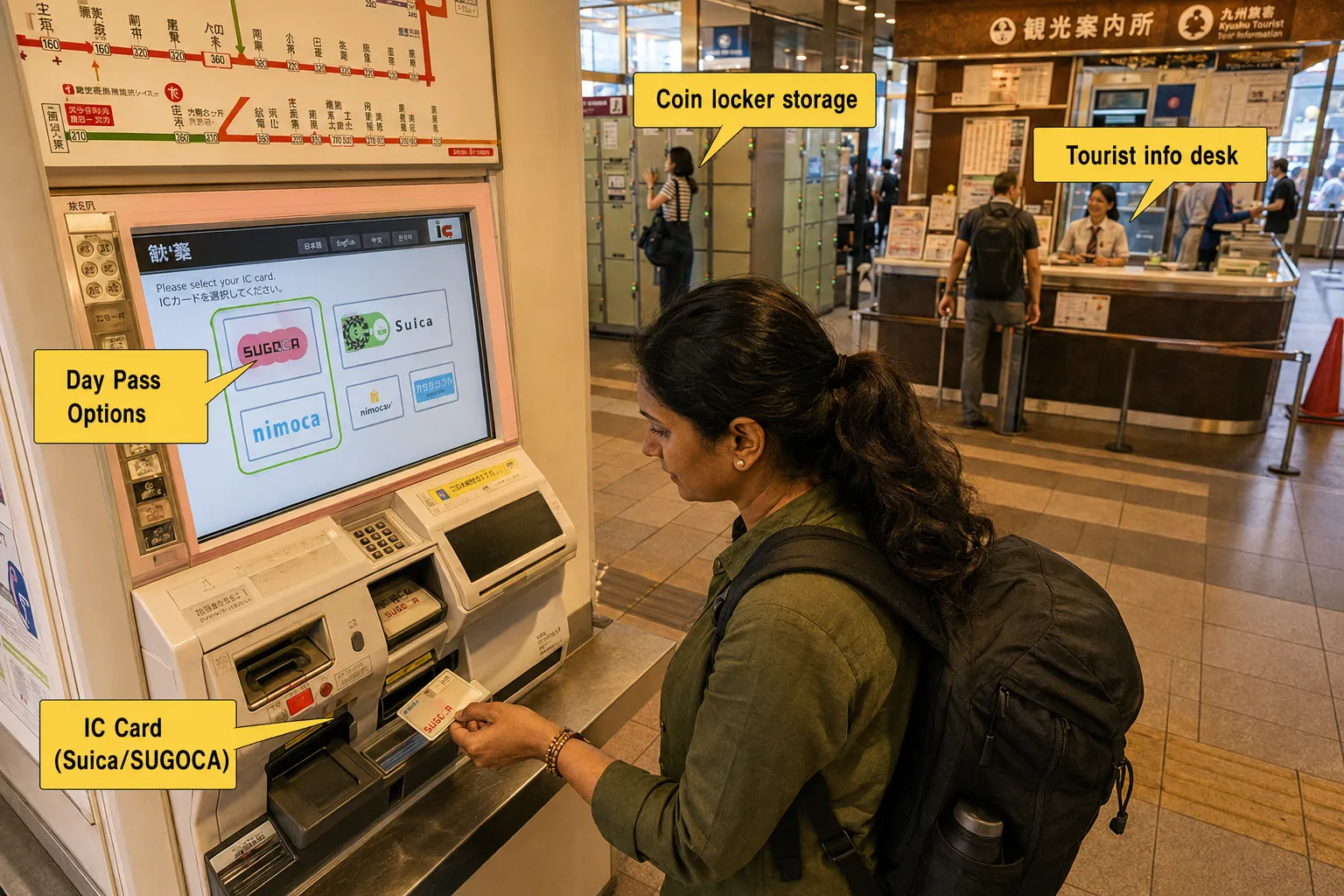
- IC cards (SUGOCA or Suica) work on most local buses and trains and eliminate the need to buy individual tickets.
- Traveling in late January through early March or mid-June through July (rainy season) yields the lowest accommodation and transport prices.
- Budget guesthouses and capsule hotels near major train stations in Fukuoka, Kumamoto, and Nagasaki typically cost 2,500-4,500 yen per night.
- You can absolutely travel Kyushu without a car if you stick to the main tourist circuit: Fukuoka, Beppu, Nagasaki, Kumamoto, and Kagoshima.
- The biggest money wasters are buying individual Shinkansen tickets without a pass, booking accommodation far from train stations, and visiting during Golden Week (late April to early May).
What’s the Cheapest Way to Get Around Kyushu Japan: An Overview of Your Options
The single most cost-effective strategy for getting around Kyushu is combining a rail pass for long intercity legs with IC card top-ups for local transport. No single method works for every situation, but this hybrid approach consistently delivers the lowest total transport cost for a 5-10 day trip.
Here is a side-by-side look at the main options:
| Transport Type | Best For | Approx. Cost (one-way, Fukuoka-Kagoshima) | Speed |
|---|---|---|---|
| Shinkansen (with pass) | Intercity, speed priority | Covered by pass (~18,000 yen/5 days) | ~1.5 hours |
| Highway Bus | Budget intercity | ~3,000-4,000 yen | ~4-5 hours |
| Local JR Train | Short regional hops | ~500-1,500 yen | Varies |
| Rental Car | Rural/volcanic areas | ~5,000-8,000 yen/day + tolls + fuel | Flexible |
| City Bus (IC card) | Within cities | ~100-230 yen per ride | Moderate |
| Overnight Bus | Saving on accommodation | ~3,500-6,000 yen | Overnight |
Cost estimates are approximate as of 2026 and subject to change. Always verify current fares on the JR Kyushu or Willer Express websites before booking.
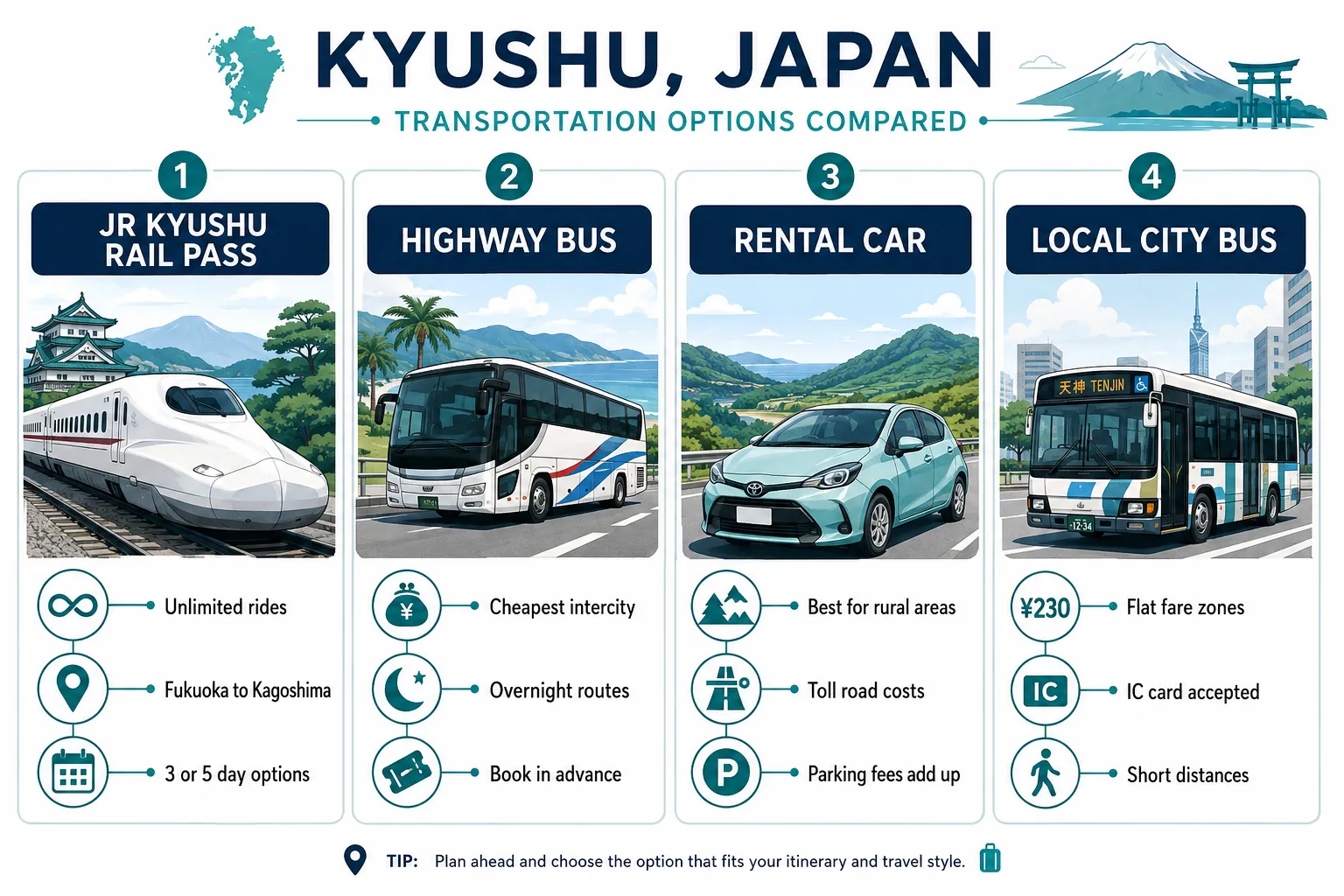
Choose the rail pass if you plan to visit four or more cities in five days. Choose highway buses if you have more time than money and flexibility in your schedule. Choose a rental car only if your itinerary includes Aso caldera, rural Oita hot springs, or Yakushima island, where public transport is infrequent.
How Much Does It Cost to Travel Kyushu by Train?
Train travel in Kyushu ranges from very affordable to moderately expensive depending on whether you buy individual tickets or use a pass. A single unreserved Shinkansen ticket from Hakata (Fukuoka) to Kagoshima-Chuo costs approximately 10,450 yen one-way as of 2026. Doing that round trip alone nearly justifies the cost of a 5-day All Kyushu Rail Pass.
JR Kyushu Rail Pass pricing (approximate, 2026):
- Northern Kyushu Pass (3 days): ~9,000 yen
- All Kyushu Pass (3 days): ~15,000 yen
- All Kyushu Pass (5 days): ~18,000 yen
The pass covers all JR Kyushu Shinkansen services, limited express trains, and many local JR lines. It does not cover non-JR buses, subway systems, or private railways like the Nishitetsu line in Fukuoka.
Common mistake: Many travelers buy the All Kyushu Pass when the Northern Kyushu Pass would have been sufficient. If your itinerary stays within Fukuoka, Nagasaki, Beppu, and Kumamoto, the Northern Pass saves money. Only add the All Kyushu Pass if you’re heading to Kagoshima or Miyazaki.
Best Cheap Transportation Passes for Kyushu
The JR Kyushu Rail Pass is the most widely used budget pass, but it is not always the cheapest option for every traveler. The right pass depends entirely on your route and travel pace.
Top passes to consider:
- JR Kyushu Rail Pass (All Kyushu, 5-day): Best for travelers covering the full island. Unlimited Shinkansen and express trains.
- JR Kyushu Rail Pass (Northern Kyushu, 3-day): Best for Fukuoka-based itineraries including Nagasaki and Beppu.
- Sunq Pass (All Kyushu, 3-day): A highway bus pass covering most intercity bus routes across Kyushu. Costs approximately 10,000 yen for 3 days. Significantly cheaper than the rail pass but much slower.
- Fukuoka City Pass (1-day): Covers Fukuoka subway and some buses for around 700 yen. Excellent value if spending a full day exploring the city.
- SUGOCA IC Card: Not a pass per se, but loading this rechargeable card saves time and gives a small discount on local transport across Kyushu.
Edge case: The Sunq Pass is particularly underrated. For travelers who are not in a rush and want to visit smaller towns not served by Shinkansen, it covers routes that the JR pass does not, including direct buses to Nagasaki, Beppu, and Miyazaki.
Kyushu Rail Pass: Worth It or Are There Better Alternatives?
The JR Kyushu Rail Pass is worth it if you plan to take at least three Shinkansen or limited express journeys during the pass period. If you only plan one or two long-distance trips, individual tickets or the Sunq bus pass will likely be cheaper.
Break-even calculation (approximate):
A Hakata-to-Kagoshima Shinkansen ticket costs roughly 10,450 yen. A Hakata-to-Beppu limited express (Sonic) costs around 4,750 yen. Those two trips alone total about 15,200 yen, which already approaches the cost of the 3-day All Kyushu Pass at around 15,000 yen. Add any third journey and the pass pays for itself.
The pass is NOT worth it if:
- Your trip is entirely within Fukuoka city
- You are traveling slowly and prioritizing buses over trains
- You are visiting only one or two cities outside Fukuoka
Better alternatives in those cases:
- Buy individual tickets for one or two long routes
- Use the Sunq Pass for bus-heavy itineraries
- Rely on IC card top-ups for regional JR local trains
Kyushu Bus Passes vs Train Passes: Which is Cheaper?
For pure cost savings, bus passes beat train passes on almost every intercity route. The Sunq Pass at roughly 10,000 yen for 3 days (all Kyushu) costs significantly less than the JR Rail Pass equivalent, but the trade-off is time.
Direct comparison for a Fukuoka-Nagasaki-Beppu-Kagoshima circuit:
- By JR Rail Pass (5-day All Kyushu): ~18,000 yen, travel time roughly 6-8 hours total across all legs
- By Sunq Bus Pass (3-day All Kyushu): ~10,000 yen, travel time roughly 14-18 hours total across the same legs
The bus pass saves approximately 8,000 yen but costs around 8-10 extra hours of travel time. That trade-off is reasonable for slow travelers but impractical for anyone with a tight itinerary.
Decision rule: Choose the bus pass if you have 10 or more days in Kyushu and enjoy the journey. Choose the rail pass if you have 5-7 days and want to maximize sightseeing time.
Is Renting a Car Cheaper Than Trains in Kyushu?
Renting a car is not cheaper than trains for the main tourist circuit, but it becomes cost-effective for rural areas. For routes between major cities like Fukuoka, Kumamoto, and Kagoshima, the combination of car rental fees (5,000-8,000 yen per day), expressway tolls (roughly 3,000-6,000 yen per long stretch), and parking fees (500-1,500 yen per location) adds up quickly.
However, for areas like:
- Aso caldera and surrounding volcanic highlands
- Rural Oita prefecture (Yufuin, Kurokawa Onsen)
- Southern Kagoshima and Ibusuki
- Yakushima island (requires ferry + car)
…a rental car is often the only practical option, and splitting the cost between two or three travelers makes it genuinely affordable.
Practical tip: Book rental cars at least two weeks in advance through Nippon Rent-A-Car or Toyota Rent a Car for the best rates. Compact kei cars (light vehicles) are the cheapest option and handle mountain roads well.
Can You Travel Kyushu Without a Car?
Yes, you can travel Kyushu’s main tourist destinations entirely without a car. Fukuoka, Nagasaki, Kumamoto, Beppu, and Kagoshima are all well-connected by Shinkansen, limited express trains, and intercity buses. Each city has its own subway or bus network for local sightseeing.
Car-free itinerary is fully viable for:
- Fukuoka (Hakata): Subway and walking cover everything
- Nagasaki: Trams cover all major sights for 140 yen per ride
- Kumamoto: City trams and buses reach Kumamoto Castle easily
- Beppu: Local buses connect all major onsen districts
- Kagoshima: City trams and the Sakurajima ferry are straightforward
Where a car genuinely helps:
- Mount Aso (bus service exists but is infrequent)
- Takachiho Gorge in Miyazaki (very limited public transport)
- Yakushima (ferry required, then limited bus on the island)
For a first-time visitor sticking to the classic Kyushu circuit, a car is an optional luxury, not a necessity.
How to Travel Kyushu on a Budget Per Day
A realistic daily budget for Kyushu travel in 2026 breaks down as follows, assuming a mid-range backpacker style:
Daily budget estimate (per person):
- Accommodation: 2,500-4,500 yen (capsule hotel or budget guesthouse)
- Food: 1,500-2,500 yen (convenience store meals + one sit-down meal)
- Local transport: 300-700 yen (IC card for city buses/trains)
- Attractions: 500-1,500 yen (many temples and parks are free)
- Total: approximately 5,000-9,200 yen per day (roughly $33-62 USD at mid-2026 exchange rates)
Long-distance transport (rail pass or bus pass) is best treated as a fixed upfront cost spread across the trip rather than a daily expense.
Kyushu budget travel tips and tricks:
- Eat at convenience stores (7-Eleven, FamilyMart, Lawson) for breakfast and lunch. A full meal costs 500-700 yen.
- Visit free attractions: Dazaifu Tenmangu shrine, Nagasaki’s Glover Garden outer areas, Fukuoka’s canal city.
- Use 100-yen shops for snacks and toiletries instead of tourist-area shops.
- Book accommodation at least two weeks ahead, especially in Beppu and Fukuoka.
- Avoid taxis entirely. They start at around 700 yen and climb fast.
- Use Google Maps in offline mode to navigate local bus routes without data costs.
Cheapest Cities to Visit in Kyushu Japan
Not all Kyushu cities cost the same. Some have higher accommodation prices and more expensive attraction entry fees. The most budget-friendly cities in Kyushu are Kumamoto and Kagoshima, where accommodation is plentiful and many major sights are free or low-cost.
Budget ranking (most affordable first):
- Kumamoto: Budget guesthouses from 2,500 yen/night. Kumamoto Castle grounds are partially free. Excellent ramen and local food scene.
- Kagoshima: Affordable capsule hotels near the station. Sakurajima ferry costs only 200 yen round trip. Strong local food culture.
- Beppu: Mid-range. Onsen entry fees add up (budget 500-1,000 yen per bath house visit), but accommodation is reasonable.
- Nagasaki: Slightly pricier due to tourist demand, but tram day passes (500 yen) keep local transport cheap.
- Fukuoka (Hakata): Most expensive of the five, but also the best transport hub. Staying here as a base and doing day trips saves money overall.
What Months Are Cheapest to Visit Kyushu
The cheapest months to visit Kyushu are late January through early March and mid-June through mid-July (the rainy season). During these periods, both accommodation prices and tourist crowds drop significantly.
Seasonal cost guide:
- Peak (most expensive): Late March to early April (cherry blossom season), late April to early May (Golden Week), October to November (autumn foliage)
- Shoulder (moderate): September, early October, late November, early December
- Off-peak (cheapest): January-February, mid-June to mid-July
The rainy season (tsuyu) in June-July brings frequent rain but also lush green landscapes, uncrowded onsen, and hotel rates that can be 20-30% lower than peak season. Packing a compact umbrella and embracing the weather makes this an excellent budget window.
Avoid at all costs for budget travel: Golden Week (late April to May 5). Trains and buses book out weeks in advance, accommodation prices double, and popular sights are extremely crowded.
Kyushu Travel Mistakes That Waste Money
Several common errors consistently drain travel budgets in Kyushu. Knowing them in advance saves meaningful money.
Top money-wasting mistakes:
- Buying individual Shinkansen tickets without checking pass math. Two or three long-distance trips almost always justify a rail pass.
- Booking accommodation far from train stations. Taxi rides from distant guesthouses to stations add 1,000-2,000 yen per trip.
- Visiting during Golden Week without advance bookings. Last-minute prices during peak periods are dramatically higher.
- Paying for airport limousine buses when subway is available. Fukuoka Airport is directly connected to Hakata Station by subway for 260 yen. The limousine bus costs significantly more.
- Not loading an IC card. Buying individual tickets for every local bus or train ride wastes time and costs slightly more than IC card fares.
- Eating every meal at sit-down tourist restaurants. A single tourist-area set meal can cost 1,500-2,500 yen. Convenience store meals or local ramen shops deliver better value at 500-900 yen.
- Skipping free sights in favor of paid attractions. Kyushu has dozens of outstanding free shrines, volcanic viewpoints, and coastal paths.
How Many Days Do You Need to Explore Kyushu
Five to seven days is the practical minimum to cover Kyushu’s main highlights without feeling rushed. Ten to fourteen days allows a thorough exploration including rural areas and smaller towns.
Recommended itinerary lengths:
- 5 days: Fukuoka, Nagasaki, Kumamoto, and Kagoshima. Use the 5-day All Kyushu Rail Pass. Fast-paced but achievable.
- 7 days: Add Beppu and one rural day trip (Aso or Yufuin). Best balance of coverage and cost.
- 10-14 days: Add Miyazaki, Yakushima, and slower exploration of smaller towns. Switch to a mix of bus passes and IC card travel.
Edge case: Travelers with only 3 days are better served by the Northern Kyushu Pass and a tight Fukuoka-Nagasaki-Beppu loop rather than trying to rush the entire island.
Budget Accommodation Near Kyushu Train Stations
Staying within walking distance of major train stations is one of the most effective ways to cut daily transport costs in Kyushu. Most budget options cluster within 5-10 minutes of the main stations.
Best budget accommodation types:
- Capsule hotels: 2,500-3,500 yen/night. Found near Hakata, Kumamoto, and Kagoshima-Chuo stations. Clean, secure, and practical for solo travelers.
- Guesthouses and hostels: 2,500-4,500 yen/night. Often include free breakfast, communal kitchens, and local advice from staff.
- Business hotels (budget chains): Toyoko Inn and Super Hotel chains offer rooms from 5,000-7,000 yen/night, often with free breakfast included.
Recommended areas by city:
- Fukuoka: Stay in Hakata or Tenjin districts, both walkable to Hakata Station.
- Nagasaki: Stations area or Shianbashi district for tram access.
- Kumamoto: Within 10 minutes of Kumamoto Station or near the tram line.
- Beppu: Beppu Station area has multiple budget guesthouses.
- Kagoshima: Kagoshima-Chuo Station area for Shinkansen and tram access.
Booking tip: Use Jalan or Rakuten Travel (Japanese booking platforms) alongside Booking.com and Hostelworld. Japanese domestic platforms sometimes list lower rates for the same properties.
Kyushu Japan Budget Travel Tips and Tricks: Final Checklist
Pulling all the strategies together, here is a practical pre-trip checklist for budget Kyushu travel:
- Decide your route before buying any pass. Map out every long-distance journey and calculate individual ticket costs versus pass cost.
- Purchase your JR Kyushu Rail Pass online before arriving in Japan. It is only available to foreign visitors and must be bought outside Japan or at designated counters on arrival.
- Load a SUGOCA or Suica IC card at Fukuoka Airport or Hakata Station immediately on arrival.
- Book accommodation at least two weeks in advance, especially for Beppu and Fukuoka.
- Plan travel outside Golden Week, cherry blossom peak, and autumn foliage peak if budget is the priority.
- Download Google Maps offline maps for all Kyushu prefectures before departing.
- Carry a portable umbrella. Rainy season travel is cheap, but getting caught in heavy rain near tourist sites leads to expensive taxi rides.
- Check the Kyushu Tourism Organization website for current free festival and event listings before finalizing your itinerary.
Frequently Asked Questions
Q: What is the cheapest way to travel around Kyushu Japan for a 7-day trip?
A: Buy the 5-day All Kyushu JR Rail Pass (approximately 18,000 yen) for intercity travel, load a SUGOCA IC card for local buses and trains, and stay in capsule hotels or hostels near train stations. Total transport and accommodation costs can be kept under 50,000 yen for 7 days.
Q: Is the JR Kyushu Rail Pass available to all visitors?
A: The JR Kyushu Rail Pass is available only to foreign nationals visiting Japan on a tourist visa. It must be purchased before arriving in Japan through an authorized overseas agent or at specific airport counters on arrival. Japanese residents cannot purchase it.
Q: How much does a day trip from Fukuoka to Nagasaki cost by train?
A: A round-trip limited express (Kamome) ticket from Hakata to Nagasaki costs approximately 9,000-10,000 yen without a pass. With the Northern Kyushu Rail Pass (approximately 9,000 yen for 3 days), the day trip is fully covered along with other routes.
Q: Can I use a Suica card in Kyushu?
A: Yes. Suica cards work on most IC card-compatible transport in Kyushu, including JR local trains and many city buses. However, SUGOCA (the Kyushu-specific IC card) is equally functional and available at any JR Kyushu station.
Q: What is the cheapest intercity route in Kyushu?
A: The Fukuoka to Kumamoto route is one of the shortest and cheapest long-distance trips. A highway bus costs approximately 1,500-2,000 yen one-way. By Shinkansen without a pass, it costs around 4,500 yen.
Q: Is Fukuoka expensive compared to other Kyushu cities?
A: Fukuoka is the most expensive city in Kyushu for accommodation and dining, but its transport infrastructure is the best on the island. Using it as a base for day trips can actually save money versus staying in multiple cities.
Q: Do overnight buses save money on accommodation?
A: Yes, overnight buses between major cities like Fukuoka and Osaka or Fukuoka and Kagoshima effectively replace one night of accommodation. A seat on an overnight highway bus costs approximately 3,500-6,000 yen, which is often less than a budget hotel room.
Q: What is the Sunq Pass and is it worth buying?
A: The Sunq Pass is an unlimited highway bus pass covering most of Kyushu. The 3-day All Kyushu version costs approximately 10,000 yen. It is worth buying for slow travelers who prioritize cost over speed and want to visit towns not served by Shinkansen.
Q: Are there free things to do in Kyushu?
A: Yes. Many of Kyushu’s best experiences are free or very low cost, including Dazaifu Tenmangu shrine, Nagasaki’s Dejima Wharf waterfront, Kumamoto’s Suizenji Garden (small entry fee), Sakurajima volcanic viewpoints, and Fukuoka’s Ohori Park.
Q: How early should I book transport and accommodation for Kyushu?
A: For travel during peak seasons (cherry blossom, Golden Week, autumn foliage), book at least 4-6 weeks in advance. For off-peak travel, 2 weeks is generally sufficient for accommodation. JR Rail Passes should be purchased before departing for Japan.
Conclusion
Answering the question of what is the cheapest way to travel around Kyushu Japan comes down to one core principle: match your transport method to your itinerary, not the other way around. The JR Kyushu Rail Pass delivers the best value for travelers covering four or more cities in five to seven days. The Sunq bus pass wins on pure cost for slower itineraries. A rental car only makes financial sense for rural volcanic areas where trains simply do not go.
Actionable next steps:
- Map your specific route and calculate individual ticket costs before committing to any pass.
- Purchase your JR Kyushu Rail Pass through an authorized overseas agent before flying to Japan.
- Load a SUGOCA IC card on arrival at Fukuoka Airport.
- Book accommodation within walking distance of major train stations at least two weeks in advance.
- Schedule your trip in January-February or mid-June to mid-July for the lowest overall costs.
- Check the JR Kyushu official website and Sunq Pass website for the most current pricing before finalizing your budget.
Kyushu rewards travelers who plan their transport strategy in advance. With the right pass in hand and a flexible attitude toward buses and local trains, a week on the island is well within reach for under 100,000 yen total, including accommodation, food, transport, and sightseeing.
Sources
- JR Kyushu Official Website, Rail Pass pricing and route information. https://www.jrkyushu.co.jp/english/
- Sunq Pass Official Website, Highway bus pass details and routes. https://www.sunqpass.jp/english/
- Japan National Tourism Organization (JNTO), Kyushu regional travel guide. https://www.japan.travel/en/
- Kyushu Tourism Organization, Regional travel resources and seasonal events. https://www.welcomekyushu.com/
- Willer Express, Highway bus booking and pricing. https://willerexpress.com/en/


2 comments