Last updated: August 13, 2026
Quick Answer: The cheapest digital nomad visas in Europe for 2026 include Albania (no application fee), Georgia (free to apply, though technically outside the EU), Portugal’s D8 visa (around EUR 90 in government fees), and Malta’s Nomad Residence Permit (EUR 300). Each has different income requirements, duration limits, and tax implications that affect the true cost of living legally as a remote worker in Europe.
Key Takeaways
- Albania offers the lowest barrier to entry with no official application fee and a straightforward process for remote workers.
- Portugal’s D8 Digital Nomad Visa costs approximately EUR 83-90 in government fees, but requires proof of income at roughly 4x Portugal’s minimum wage.
- Spain’s Digital Nomad Visa is more expensive to apply for and has a higher income threshold, but offers access to the Beckham Law tax regime.
- Malta’s Nomad Residence Permit costs EUR 300 and is one of the few EU options with an English-language application process.
- Most European digital nomad visas require private health insurance, proof of remote income, and a clean criminal record.
- A tourist visa (Schengen 90/180-day rule) is free but legally prohibits working for most nationalities, making a proper nomad visa the safer long-term choice.
- Processing times range from 4 weeks (Albania) to 3-4 months (Portugal, Spain), so plan well ahead.
- Family members can typically join on a dependent permit, though this adds cost and paperwork.
What Is a Digital Nomad Visa and How Does It Work?
A digital nomad visa is a legal residence permit that allows remote workers to live in a foreign country while earning income from clients or employers based elsewhere. Unlike a standard work visa, it does not require a local employer to sponsor you.
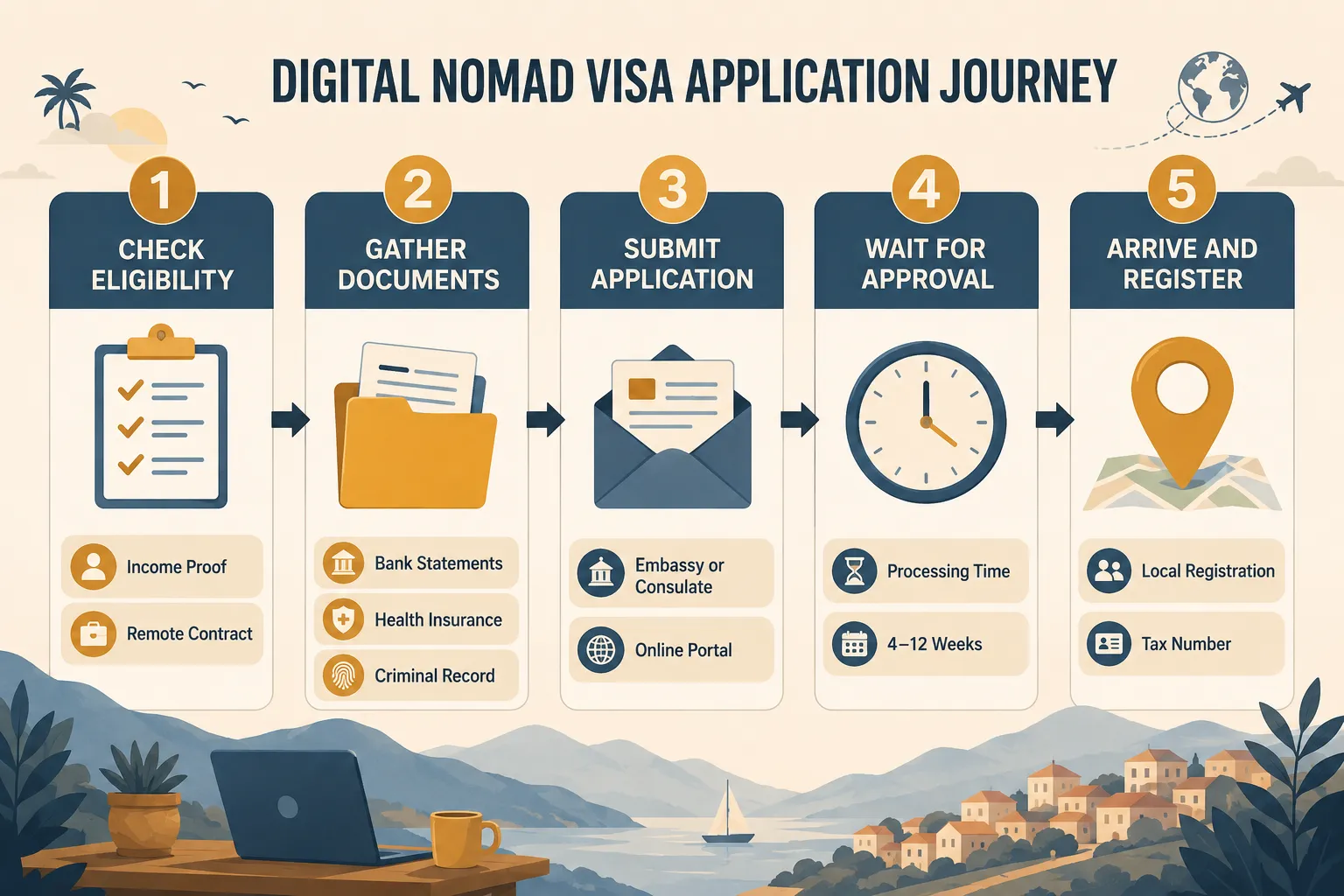
Here is how the process works in practice:
- You apply at the country’s consulate or immigration authority, either before arrival or in-country.
- You prove that your income comes from outside the host country (via contracts, bank statements, or employer letters).
- You pay government fees, submit supporting documents, and wait for approval.
- Once approved, you receive a residence permit valid for 1-2 years, often renewable.
The key distinction: a digital nomad visa lets you stay legally beyond the standard 90-day tourist limit and, in most cases, lets you access local services like banking and healthcare enrollment.
Which European Countries Offer Digital Nomad Visas in 2026?
As of 2026, more than a dozen European countries have formal digital nomad or remote work visa programs. The most established options include:
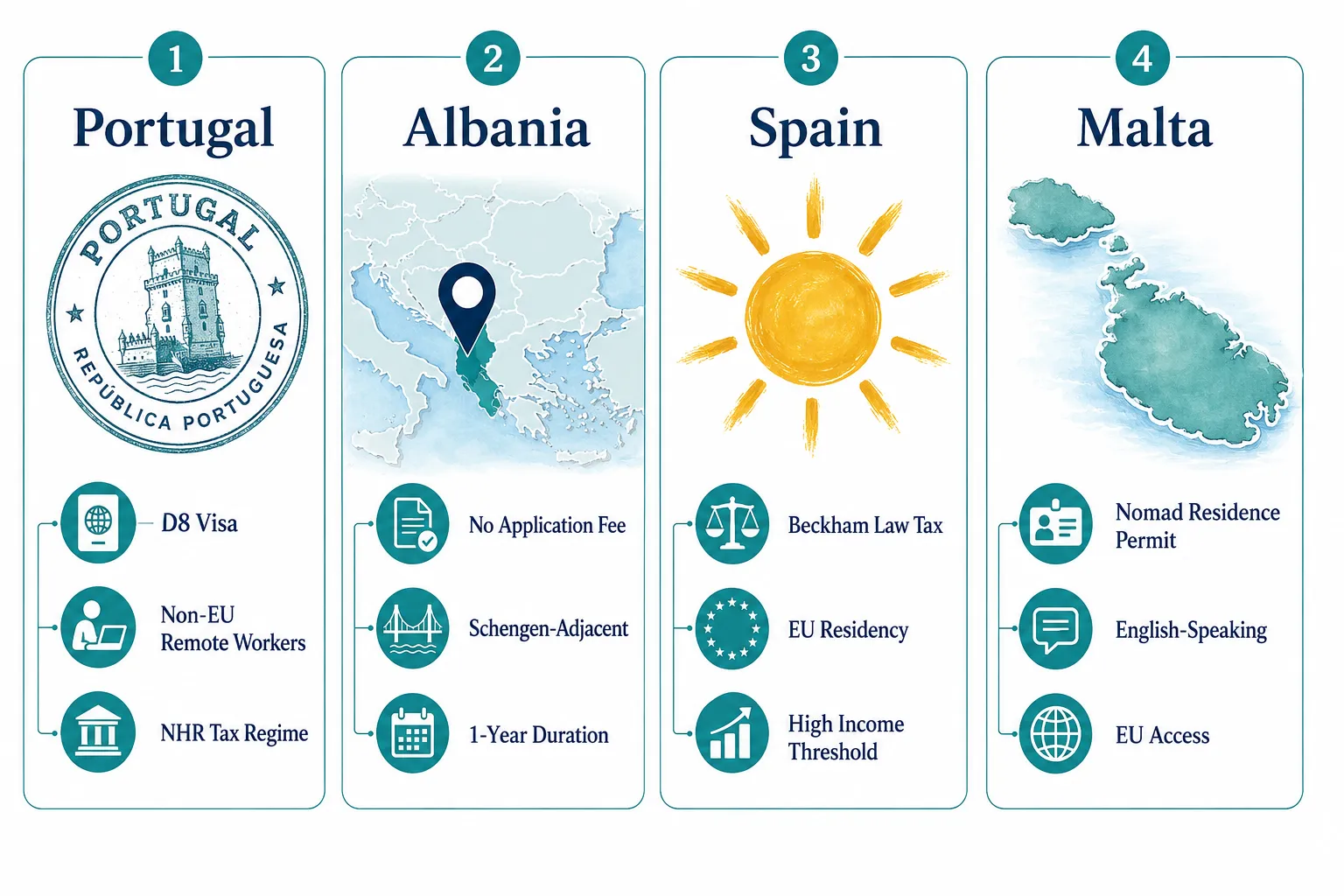
| Country | Visa Name | Government Fee (approx.) | Min. Monthly Income Required | Max. Stay |
|---|---|---|---|---|
| Portugal | D8 Digital Nomad Visa | EUR 83-90 | ~EUR 3,040 | 2 years (renewable) |
| Spain | Digital Nomad Visa | EUR 70-80 (consulate fee) | ~EUR 2,646 | 1 year (extendable to 5) |
| Malta | Nomad Residence Permit | EUR 300 | EUR 2,700 gross/month | 1 year (renewable) |
| Albania | Digital Nomad Visa | No fee | USD 800/month (est.) | 1 year |
| Croatia | Digital Nomad Residence Permit | ~EUR 50-100 | HRK 16,907/month (~EUR 2,240) | 1 year |
| Greece | Digital Nomad Visa | EUR 75 | EUR 3,500/month | 1 year (renewable) |
| Estonia | Digital Nomad Visa | EUR 80-100 | EUR 4,500/month (gross) | 1 year |
| Czech Republic | Zivno (Freelance Visa) | CZK 2,500 (~EUR 100) | Varies | 1-2 years |
Note: Fee amounts are approximate government charges only. Legal and translation fees, notarization, and health insurance add significantly to the real total cost.
Countries like Romania, Hungary, and Iceland also have programs or are in advanced stages of launching them as of 2026. Always verify current requirements directly with the relevant consulate before applying, as rules change.
Cheapest Digital Nomad Visa Europe 2026: A Full Cost Comparison
The cheapest digital nomad visas in Europe for 2026, ranked by total upfront cost, are Albania, Croatia, Portugal, and Greece. However, the application fee is rarely the biggest expense, income thresholds and health insurance premiums matter more.
True cost breakdown (beyond the application fee):
- Health insurance: Most countries require coverage of at least EUR 30,000. Annual premiums for a healthy adult typically range from EUR 600 to EUR 1,800 depending on age and provider.
- Document preparation: Apostilles, translations, and notarizations can add EUR 100-400 per application.
- Legal/agent fees: Optional but common. Immigration lawyers in Portugal or Spain charge EUR 500-1,500 for full-service applications.
- Biometrics and in-person appointments: Some countries charge a small fee (EUR 10-30) for fingerprinting.
Choose Albania if you want the lowest possible upfront cost and are comfortable with a non-EU country that sits outside the Schengen Area but offers visa-free travel to many nearby nations.
Choose Croatia if you want EU membership, Adriatic lifestyle, and a relatively low income threshold compared to Western European alternatives.
Choose Portugal if you want long-term EU residency pathways and access to the Non-Habitual Resident (NHR) tax regime (now restructured as of 2024, but still favorable for some income types).
Digital Nomad Visa Europe Requirements and Income Thresholds
Every European digital nomad visa requires proof that your income comes from outside the host country. The specific documents and minimum income thresholds vary by country.
Standard documents required across most programs:
- Valid passport (minimum 6 months validity beyond intended stay)
- Proof of remote income (employment contract, client contracts, or business registration)
- Bank statements (typically 3-6 months)
- Private health insurance with EU-wide or country-specific coverage
- Clean criminal record certificate (apostilled)
- Proof of accommodation (rental agreement or hotel booking)
- Completed application form and passport photos
Income thresholds at a glance:
- Portugal: approximately EUR 3,040/month (4x national minimum wage, as of the current program rules)
- Greece: EUR 3,500/month
- Estonia: EUR 4,500/month gross
- Malta: EUR 2,700/month gross
- Croatia: approximately EUR 2,240/month
- Albania: approximately USD 800/month (one of the lowest in the region)
Common mistake: Applicants often submit bank statements that show irregular deposits or freelance income without a clear paper trail. Consulates want to see consistent, verifiable income, not a single large transfer the month before applying.
Can You Work Remotely for a US Company on a European Digital Nomad Visa?
Yes. Working remotely for a US-based employer or US clients is explicitly permitted under most European digital nomad visa programs. In fact, this is the primary use case these visas were designed for.
The key rule is that your employer or clients must be based outside the host country. You are not permitted to provide services directly to local businesses or take on local employment.
Practical points for US-based remote workers:
- Your US employer does not need to register in Europe or change your employment status.
- You will likely need to provide your employment contract, recent pay stubs, and a letter from your employer confirming remote work is permitted.
- Tax obligations are more complex. Once you establish tax residency in a European country (typically after 183 days), you may owe local income tax. Some countries (Portugal, Spain) have special tax regimes for new residents that reduce this burden.
- The US taxes citizens on worldwide income regardless of where they live, so US passport holders will also need to file US returns and may need to claim the Foreign Earned Income Exclusion (FEIE).
Consulting a cross-border tax advisor before relocating is strongly recommended for US citizens.
How Long Can You Stay on a Digital Nomad Visa in Europe?
Most European digital nomad visas grant an initial stay of 1 year, with the option to renew for 1-2 additional years. Portugal’s D8 visa is initially issued for 1-2 years and can be renewed, with a path to permanent residency after 5 years.
Duration by country:
- Portugal: 2 years initial, renewable, permanent residency eligible after 5 years
- Spain: 1 year initial, extendable up to 5 years total
- Malta: 1 year, renewable annually
- Croatia: 1 year, not automatically renewable (must reapply)
- Albania: 1 year, renewable
- Estonia: 1 year, renewable
Important: Staying beyond your visa’s validity without renewal is a serious immigration violation. Start the renewal process at least 60-90 days before expiry.
Digital Nomad Visa vs Tourist Visa in Europe: Which Is Better?
For stays under 90 days, a tourist visa (or visa-free entry under the Schengen Agreement) is simpler and free. For stays beyond 90 days, or for anyone who wants to work legally, a digital nomad visa is the correct choice.
Tourist visa limitations:
- Maximum 90 days in any 180-day period within the Schengen Area
- Working remotely is technically prohibited for most nationalities (enforcement varies, but the legal risk is real)
- No access to local banking, long-term rentals, or official residency services
- Cannot convert to residency without leaving the Schengen Area
Digital nomad visa advantages:
- Legal right to work remotely from the host country
- Access to local banking, SIM cards, and long-term housing contracts
- Pathway to permanent residency in most EU countries
- Ability to bring dependents
The bottom line: If you plan to stay more than 3 months or want legal certainty, a digital nomad visa is worth the cost and paperwork. The risk of overstaying or working illegally on a tourist visa includes fines, deportation, and multi-year entry bans.
For budget-focused travelers exploring short-term options, resources like this Albania 7-day road trip cost guide can help you assess whether a country fits your budget before committing to a longer visa application.
Do You Need Health Insurance for a European Digital Nomad Visa?
Yes. Private health insurance is a mandatory requirement for virtually every European digital nomad visa. Most countries require coverage of at least EUR 30,000 per incident, valid for the full duration of your stay.
What to look for in a policy:
- Coverage in the specific country (some policies exclude certain EU members)
- Minimum EUR 30,000 emergency and hospitalization coverage
- Repatriation coverage (often required by consulates)
- Policy must be in English or the local language, or accompanied by a certified translation
Recommended provider types:
- International health insurance providers (SafetyWing, Cigna Global, AXA, Allianz Care)
- Travel insurance with long-stay provisions (check that it covers “working remotely”, some policies void coverage if you are employed)
Annual premiums for a healthy adult under 40 typically run EUR 600-1,200 with SafetyWing’s Nomad Insurance and EUR 1,200-2,500 with comprehensive providers like Cigna Global. These are estimates based on publicly available pricing as of 2026, get a direct quote for your age and destination.
Digital Nomad Visa Europe for Freelancers and Self-Employed Workers
Freelancers and self-employed workers can apply for European digital nomad visas, but the documentation requirements are more demanding than for salaried employees.
What freelancers need to prove:
- Consistent income over the past 6-12 months (bank statements are critical)
- Active client contracts or signed service agreements
- Business registration in your home country (not always required, but strengthens the application)
- Tax returns from the previous year showing declared income
Country-specific notes for freelancers:
- Portugal: Accepts freelancers but requires evidence of ongoing contracts. The NHR tax regime (now the IFICI incentive regime as of 2024) may offer favorable rates for qualifying income types.
- Estonia: Particularly freelancer-friendly due to its e-Residency program, which allows you to register an EU company digitally before or during your visa application.
- Czech Republic: The Zivno (trade license) visa is specifically designed for self-employed workers and is one of the most established freelancer pathways in Central Europe.
- Spain: Requires freelancers to show they have been self-employed for at least 3 years and that their main clients are outside Spain.
Common mistake for freelancers: Applying with only a few months of income history. Most consulates want to see at least 6 months of consistent earnings at or above the income threshold.
Common Mistakes People Make Applying for Digital Nomad Visas
The most common reason digital nomad visa applications are rejected or delayed is incomplete or inconsistent documentation. Here are the mistakes that come up most often:
Submitting bank statements that do not match declared income. Consulates cross-reference your stated monthly income against actual deposits. Discrepancies trigger requests for clarification or outright rejection.
Using travel insurance instead of health insurance. Short-term travel policies rarely meet the minimum coverage requirements. Always check that your policy explicitly covers long-term stays and remote work.
Applying too late. Processing times for Portugal and Spain can reach 3-4 months. Applying while already in the country on a tourist visa creates a legal grey area.
Missing apostilles or translations. Criminal record certificates, birth certificates, and other official documents often need an apostille stamp and certified translation. Missing either one will stall the application.
Underestimating income requirements. Some applicants calculate their average income over a full year and present a monthly average that dips below the threshold in some months. Most consulates want every month above the minimum, not just the average.
Ignoring tax implications. Moving to a new country for more than 183 days creates tax residency. Failing to plan for this can result in unexpected tax bills in both the host country and your home country.
For travelers planning budget-conscious moves, checking the broader cost of living in a destination first is wise. The RoamBudget blog covers destination-specific cost breakdowns that can help with this planning.
How Long Does a Digital Nomad Visa Application Take to Process?
Processing times vary significantly by country and by how you apply (in-country vs. at a consulate abroad). Plan for 4 to 16 weeks in most cases.
Estimated processing times by country:
- Albania: 2-4 weeks
- Croatia: 4-8 weeks
- Malta: 4-6 weeks
- Greece: 6-10 weeks
- Portugal: 8-16 weeks (SEF/AIMA appointments are a known bottleneck)
- Spain: 8-12 weeks
- Estonia: 4-8 weeks
Tips to speed up processing:
- Apply at a consulate in your home country rather than in-country where possible.
- Submit a complete, well-organized application with a cover letter explaining each document.
- Use a local immigration lawyer in high-demand countries like Portugal and Spain, they often have appointment access that is not publicly available.
- Avoid peak application periods (January-March and June-August tend to be busiest).
Can Family Members Come With You on a Digital Nomad Visa?
Yes, most European digital nomad visa programs allow spouses, registered partners, and dependent children to apply as accompanying family members. They typically apply for a dependent residence permit rather than their own nomad visa.
Key points for family applications:
- The primary applicant’s income threshold usually needs to be higher to cover dependents (some countries add 50% of the base threshold per adult dependent and 30% per child).
- Each family member needs their own health insurance coverage.
- Children may need school enrollment documentation once in-country.
- Dependents generally cannot work locally under the dependent permit, they would need their own visa category to do so.
Portugal is particularly popular for families because of its pathway to citizenship after 5 years of legal residency and its well-regarded international school options. Malta is another strong choice given its English-language environment and EU membership.
Is a Digital Nomad Visa Worth It, or Should You Just Use a Tourist Visa?
A digital nomad visa is worth it if you plan to stay more than 90 days, want legal certainty, or need access to local services. For short trips or testing a destination, the Schengen tourist allowance is perfectly adequate.
When a digital nomad visa makes sense:
- You want to stay in one country for 6+ months
- You need a local bank account, long-term rental contract, or tax number
- You want to build toward permanent residency or citizenship
- You have dependents who need school enrollment or healthcare access
When a tourist visa is sufficient:
- You are testing a new country for 1-3 months before committing
- You plan to move between multiple Schengen countries and will not exceed 90 days in any one
- Your income is low enough that the cost and paperwork of a nomad visa is not justified
The Schengen 90/180 rule applies across the entire Schengen Area, not per country. Many nomads mistakenly believe they can spend 90 days in Portugal, then 90 days in Spain. That is not how the rule works, it is 90 days total across all Schengen member states within any 180-day window.
FAQ
What is the absolute cheapest digital nomad visa in Europe?
Albania’s Digital Nomad Visa has no official application fee, making it the cheapest in terms of upfront government cost. The income requirement is also among the lowest in the region, at approximately USD 800 per month.
Can I apply for a digital nomad visa while already in Europe on a tourist visa?
Some countries allow in-country applications; others require you to apply at a consulate in your home country. Portugal and Spain generally require you to apply before arrival. Albania and Croatia are more flexible. Check the specific rules for your target country before traveling.
Do digital nomad visas give you the right to work for local companies?
No. Digital nomad visas are specifically for remote workers whose income comes from outside the host country. Working for a local employer requires a standard work permit.
Is health insurance the biggest hidden cost of a digital nomad visa?
For most applicants, yes. Annual health insurance premiums can range from EUR 600 to EUR 2,500 depending on age, provider, and coverage level, often exceeding the government application fee many times over.
Can I get a digital nomad visa if I am retired and living off investments?
Some countries accept passive income (dividends, rental income, pensions) as qualifying income. Portugal’s D8 visa has been used by retirees, though the program is primarily designed for active remote workers. Check with a local immigration attorney for your specific situation.
How does the Schengen 90/180 rule affect digital nomads?
The 90/180 rule limits visa-free stays across the entire Schengen Area to 90 days in any rolling 180-day period. A digital nomad visa for a Schengen member country replaces this limit with a full legal residence permit, allowing you to stay for the visa’s duration.
Do I need to pay taxes in the country where I hold a digital nomad visa?
Once you are tax resident (typically after 183 days in a calendar year), yes. Most European countries will expect you to file and pay local income tax. Some, like Portugal and Spain, offer preferential tax regimes for new residents. Always get cross-border tax advice before relocating.
What happens if my digital nomad visa application is rejected?
You can typically reapply after addressing the reason for rejection. Common fixes include providing additional income documentation, upgrading your health insurance policy, or obtaining missing apostilles. Some applicants use an immigration lawyer for the second attempt.
Is Estonia’s e-Residency the same as a digital nomad visa?
No. e-Residency is a digital identity that allows you to register and manage an EU company remotely. It does not grant the right to live in Estonia. You still need Estonia’s Digital Nomad Visa for legal residency.
Can I renew my digital nomad visa indefinitely?
Most countries allow 1-2 renewals. After that, you typically need to transition to a different residence category (long-term resident, self-employed permit, or permanent residency). Portugal offers the clearest path to permanent residency after 5 years.
Are there digital nomad visa options outside the EU in Europe?
Yes. Albania, Georgia (in the Caucasus), and North Macedonia have remote work programs. These are outside the EU and Schengen Area, which means they do not count against your Schengen 90-day allowance, a significant advantage for nomads who also want to spend time in EU countries.
How much money should I budget for a full digital nomad visa application?
A realistic budget for documents, health insurance, government fees, and legal assistance ranges from EUR 1,500 to EUR 3,500 for the first year, depending on the country and whether you use an immigration lawyer. Albania and Croatia are at the lower end; Portugal and Spain tend to be higher due to legal complexity.
Conclusion
The cheapest digital nomad visas in Europe for 2026 are not simply about the lowest application fee. Albania stands out for zero government fees and a low income threshold. Croatia and Portugal offer strong value for those who want EU access. Malta suits English-speaking applicants who want a straightforward process. Greece and Spain cost more upfront but offer lifestyle and tax advantages that may justify the expense.
Actionable next steps:
- Decide on your target country based on income threshold, lifestyle fit, and tax implications, not just the application fee.
- Get a health insurance quote from at least two providers before applying. This is often the largest single cost.
- Gather your financial documents (bank statements, contracts, tax returns) for the past 6-12 months and check they consistently meet the income threshold.
- If applying for Portugal or Spain, start the process at least 4-5 months before your intended move date.
- Consult a cross-border tax advisor, especially if you are a US citizen or have income from multiple countries.
- For budget planning in potential destinations, the Albania 7-day road trip cost guide is a useful reference for Balkan cost-of-living estimates, and the RoamBudget blog covers broader destination budgeting for nomads.
The legal and financial groundwork takes time, but the payoff is the ability to live and work in Europe without the constant pressure of the 90-day clock.
References
- European Commission, Entry and Residence for Digital Nomads, ec.europa.eu, 2023
- Portugal SEF/AIMA, D8 Visa Information, sef.pt, 2022
- Government of Malta, Nomad Residence Permit, residencymalta.gov.mt, 2021
- Government of Croatia, Digital Nomad Residence Permit, mup.gov.hr, 2021
- Government of Albania, Digital Nomad Visa Program, punetejashtme.gov.al, 2022
- IRS, Foreign Earned Income Exclusion, irs.gov, 2023
- SafetyWing, Nomad Insurance Pricing, safetywing.com, 2024

