Last updated: August 14, 2026
Disclaimer: This post contains affiliate links. We may earn a commission if you make a purchase through our links, at no extra cost to you.
Quick Answer
Budget travel costs far more than advertised fares suggest. Hidden fees from airlines, currency exchanges, tourist attractions, and accommodation add-ons routinely add 30 to 60 percent on top of base prices. Understanding the hidden costs of budget travel and the seven most common expense traps lets travelers plan realistic budgets and avoid unpleasant surprises.
Key Takeaways
- Budget airlines frequently charge for carry-on bags, seat selection, and check-in at the airport, turning a cheap base fare into a much higher final cost.
- Currency exchange booths at airports and tourist areas apply markups of 5 to 15 percent above the mid-market rate, according to Wise (2024).
- Accommodation platforms often add cleaning fees, city taxes, and resort fees that are not shown in the headline price.
- Tourist attraction pricing varies by booking channel, and buying at the gate or through third-party kiosks is almost always the most expensive option.
- Travel insurance is one of the most commonly skipped budget line items, yet a single medical evacuation abroad can cost tens of thousands of dollars.
- Connectivity costs (roaming charges, airport Wi-Fi fees) are easy to overlook but add up quickly on longer trips.
- The cheapest time to travel can reduce total trip costs by 20 to 40 percent, but only if hidden fees are also controlled.
- Solo travelers and families face different hidden cost structures, and planning strategies should reflect those differences.
What Are Hidden Costs in Budget Travel That People Don’t Expect
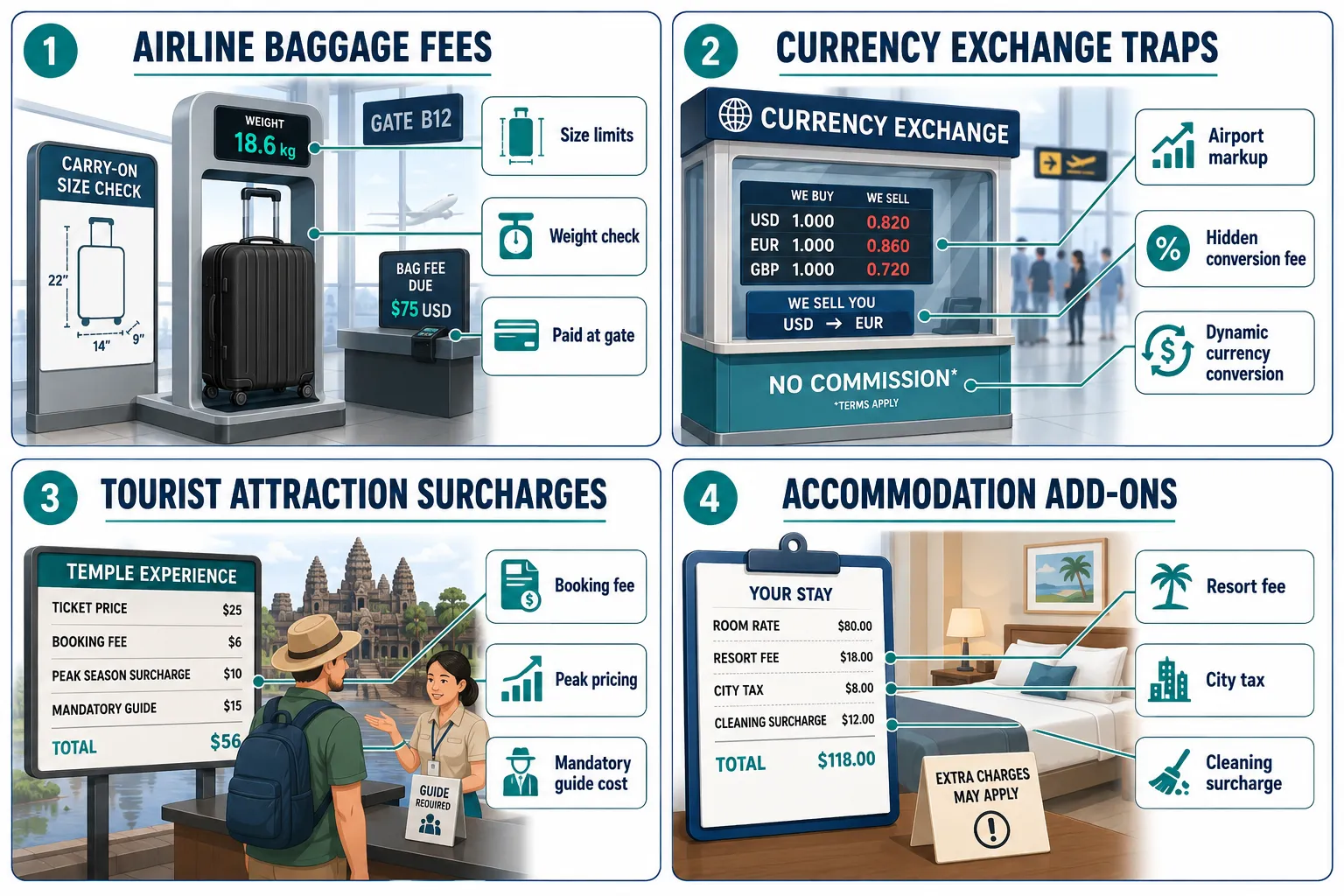
Budget travelers most often overlook fees that are not included in the advertised price: airline ancillary charges, accommodation add-ons, currency conversion markups, and tourist-area pricing premiums. These costs are legal, common, and deliberately structured to appear only after a traveler has already committed to a purchase.
The hidden costs of budget travel fall into a few predictable categories:
- Transport extras: Baggage fees, seat selection, airport check-in surcharges, and fuel levies.
- Accommodation add-ons: Cleaning fees, resort fees, city taxes, and mandatory breakfast charges.
- Currency and payment fees: Exchange rate markups, ATM withdrawal fees, and dynamic currency conversion.
- Attraction and activity surcharges: Booking platform fees, peak-hour pricing, and mandatory guide fees.
- Connectivity costs: International roaming, airport Wi-Fi, and SIM card purchases.
- Health and safety costs: Travel insurance, vaccinations, and visa fees that are easy to defer but expensive to skip.
- Food and transport in tourist zones: Restaurants and taxis near major attractions charge a significant premium over local prices.
Common mistake: Many budget travelers calculate their trip cost using only the base airfare and accommodation headline price. A realistic budget must include all seven categories above before any money is spent.
How Much Do Travel Fees and Surcharges Actually Add Up
Fees and surcharges can add 30 to 60 percent to the advertised cost of a budget trip. A traveler who books a $40 flight and a $25-per-night hostel may realistically spend $70 on the flight (after baggage and seat fees) and $35 per night on accommodation (after taxes and cleaning fees).
Here is a realistic breakdown of common hidden charges on a seven-day solo trip:
| Fee Category | Typical Hidden Cost (USD estimate) | How to Reduce It |
|---|---|---|
| Airline baggage + seat fees | $20 – $80 per flight | Pack carry-on only; check airline policy before booking |
| Currency exchange markup | 5 – 15% of cash exchanged | Use Wise, Revolut, or a local ATM with low fees |
| Accommodation add-ons | $5 – $40 per night | Read full price breakdown before booking; book direct |
| Tourist-zone food and transport | $10 – $30 per day premium | Eat and travel one block off main tourist streets |
| Connectivity (roaming/SIM) | $5 – $50 for the trip | Buy a local SIM or use an eSIM before departure |
| Attraction booking fees | $3 – $15 per booking | Book directly through official attraction websites |
| Travel insurance (if skipped) | $0 budgeted vs. $5,000+ risk | Budget $3 – $8 per day for basic coverage |
Edge case: On multi-stop itineraries, every flight segment multiplies the baggage and seat fees. A three-leg trip with a budget carrier can generate $150 to $300 in ancillary fees alone.
Why Budget Travel Is More Expensive Than It Seems
Budget travel is more expensive than it appears because the travel industry is built around separating the base price from the full cost. Airlines, accommodation platforms, and tour operators all use unbundled pricing to display the lowest possible number at the top of a search result.
Three structural reasons explain this pattern:
Unbundled pricing models. Budget carriers like Ryanair, Spirit, and AirAsia charge separately for nearly every service that legacy carriers include in the ticket price. According to the International Air Transport Association (IATA, 2023), ancillary revenues for airlines globally exceeded $100 billion, with a significant share coming from baggage and seat fees.
Dynamic pricing. Accommodation platforms and attraction booking sites adjust prices based on demand, search history, and booking timing. A hostel listed at $18 per night may cost $28 by the time taxes, cleaning fees, and service charges are added at checkout.
Tourist-zone premiums. Restaurants, taxis, and shops within walking distance of major attractions routinely charge 50 to 200 percent more than the same goods and services cost one kilometer away. This is not fraud; it is standard market pricing for a captive audience.
“The advertised price is the starting point of a negotiation between the traveler and the travel industry, not the final cost.”, A principle every experienced budget traveler learns quickly.
For a practical example of how these dynamics play out in a specific destination, see this Albania 7-day road trip cost and full budget guide, which breaks down real per-day costs including hidden fees.
What Hidden Fees Do Budget Airlines Charge
Budget airlines charge fees for services that full-service carriers include in the base fare: checked baggage, carry-on bags above a certain size, seat selection, airport check-in, priority boarding, and in-flight meals. These fees vary by airline and route, but they consistently raise the effective ticket price.
The most common budget airline fees in 2026:
- Carry-on bag fee: Many ultra-low-cost carriers now charge $10 to $60 for a standard carry-on if it does not fit under the seat in front.
- Checked baggage fee: Typically $25 to $75 per bag per flight, higher if added at the airport rather than online.
- Seat selection fee: $5 to $40 per seat per flight. Skipping this means the airline assigns a seat, often separating travel companions.
- Airport check-in fee: Some carriers charge $25 to $55 for checking in at the airport counter instead of online.
- Flight change and cancellation fees: Often $50 to $200 per ticket, making “cheap” flights expensive if plans change.
Decision rule: Before booking any budget airline ticket, use the airline’s fee schedule to calculate the total cost with at least one carry-on bag. If that total exceeds the price of a legacy carrier ticket on the same route, the legacy carrier is the better deal.
For a detailed look at how to keep connectivity costs low on a budget trip, the best eSIM cards for traveling to Oman with price and coverage comparison is a useful reference for understanding data costs abroad.
What’s the Difference Between Budget Travel and Backpacking on a Tight Budget
Budget travel is a broad term covering any trip planned to minimize costs, while backpacking on a tight budget is a specific style that prioritizes maximum flexibility and minimum daily spend, typically using hostels, overnight buses, and free or low-cost activities. The hidden cost structure differs between the two.
Budget travel often involves booking in advance, using deal-finding tools, and accepting some comfort trade-offs. Travelers may still fly, use mid-range accommodation, and book organized tours.
Backpacking on a tight budget typically means:
- Staying in dormitory-style hostels ($8 to $20 per night in most of Southeast Asia and Eastern Europe).
- Using overnight trains or buses to save on accommodation costs.
- Cooking in hostel kitchens or eating from street food stalls.
- Relying on free walking tours, public beaches, and hiking instead of paid attractions.
The hidden costs that hit backpackers hardest are different from those that affect standard budget travelers. Backpackers are more exposed to currency exchange fees (because they carry cash), transport surcharges (because they book last-minute), and health costs (because they often skip insurance).
Choose backpacking if: flexibility matters more than comfort, the destination has a strong hostel culture, and the trip is longer than two weeks (daily costs drop significantly over time).
Choose structured budget travel if: time is limited, the destination has fewer budget infrastructure options, or the traveler is part of a family or group.
How to Avoid Tourist Traps and Overpriced Attractions
The most effective way to avoid tourist traps is to book attractions directly through official websites, research local pricing before arrival, and physically move one or two blocks away from the main tourist corridor before buying food, transport, or souvenirs.
Practical steps to avoid overpriced attractions:
- Book directly. Third-party booking platforms add service fees of $3 to $15 per transaction. The official museum, park, or tour operator website almost always offers the same ticket at a lower price.
- Check for free entry days. Many major museums in Europe, the US, and Asia offer free or discounted entry on specific days or times. Google the attraction name plus “free entry 2026” before paying.
- Avoid guided tours at the gate. Tours sold at the entrance of popular sites are consistently the most expensive option. Book the same tour online 24 to 48 hours in advance for 20 to 40 percent less.
- Use city passes selectively. City tourist passes (like the Paris Museum Pass or the Tokyo Grutto Pass) save money only if the traveler plans to visit enough included attractions. Calculate the break-even point before buying.
- Eat and drink away from the main square. In most European and Asian cities, restaurants on the main tourist square charge 40 to 100 percent more than restaurants two streets away.
For travelers exploring Japan on a budget, the cheapest ways to travel around Kyushu Japan in 2026 covers transport and attraction costs in detail.
Common Mistakes Budget Travelers Make That Cost Them Money
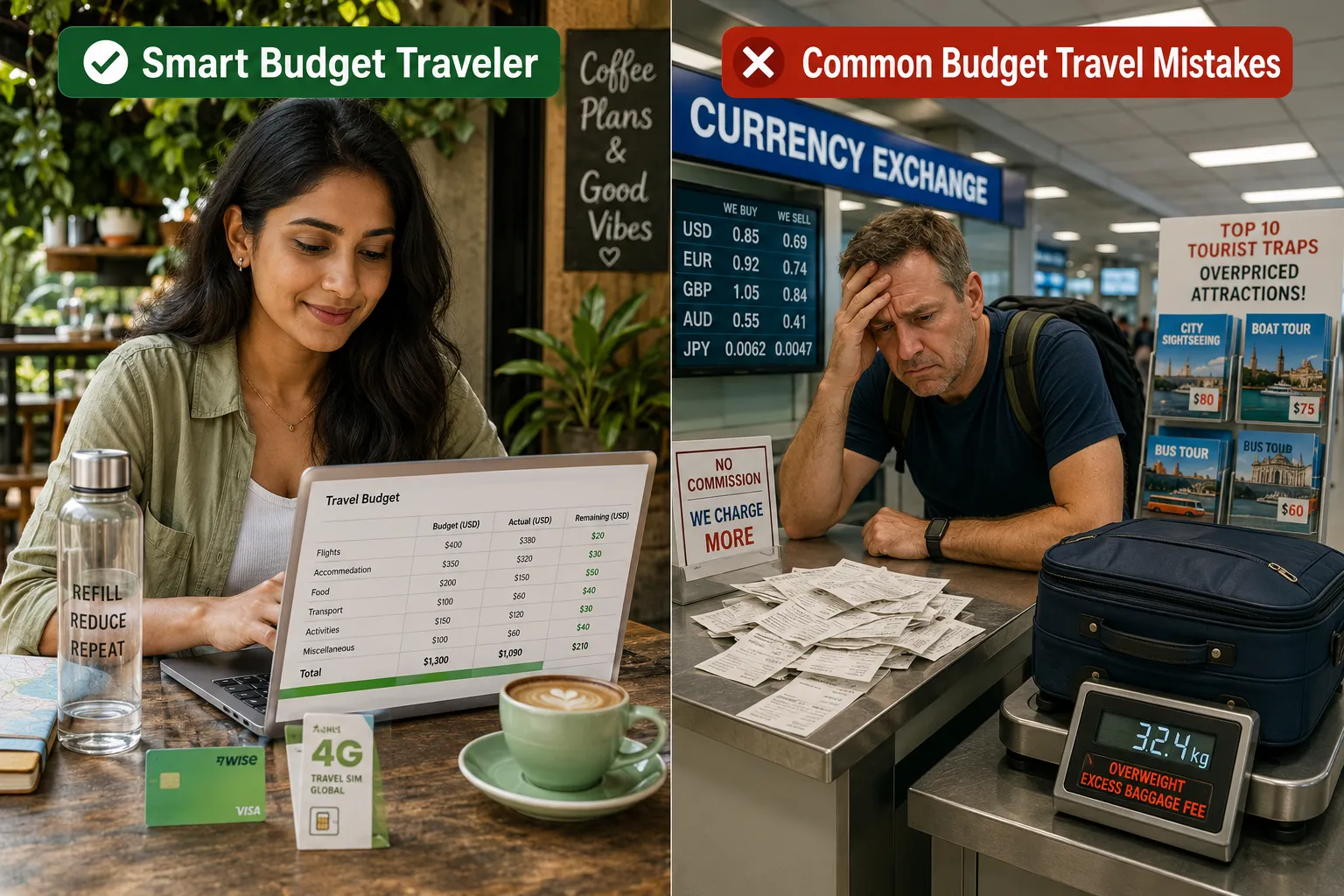
The most expensive mistake budget travelers make is optimizing for the lowest headline price without calculating the total cost. Other common and costly errors include skipping travel insurance, ignoring currency exchange rates, and failing to read accommodation cancellation policies.
The seven most common and costly budget travel mistakes:
Booking the cheapest flight without checking baggage fees. A $30 fare with $60 in baggage fees is worse than a $70 fare with one free checked bag.
Using airport currency exchange booths. Airport exchange rates are consistently the worst available. Wise (2024) reports that airport booths can charge 10 to 15 percent above the mid-market rate.
Skipping travel insurance. A single hospital visit abroad can cost $500 to $5,000. A medical evacuation can exceed $50,000. Budget travelers who skip insurance are self-insuring against a catastrophic risk. SafetyWing offers nomad-focused coverage starting at approximately $1.50 per day (SafetyWing, 2024).
Booking non-refundable accommodation without reading the cancellation policy. Flight delays, visa issues, or illness can make a non-refundable booking a complete loss.
Ignoring dynamic currency conversion (DCC). When a foreign ATM or card terminal asks “Would you like to pay in your home currency?”, always choose the local currency. DCC rates are set by the merchant’s bank and are almost always worse than the traveler’s own bank rate.
Buying data roaming from a home carrier. Roaming packages from major carriers cost $10 to $15 per day. A local SIM or eSIM for the same data costs $2 to $5 per day in most destinations.
Underestimating visa and entry costs. Visa fees, travel authorization fees (like the US ESTA or the UK ETA), and airport departure taxes are often forgotten in initial budgets. These can add $20 to $200 per trip.
How to Find Real Budget Travel Deals vs. Scams
Real budget travel deals come from booking directly, using price comparison tools, and traveling during shoulder season. Scams and fake deals typically involve prices that seem impossibly low, require immediate payment, or use unofficial booking channels.
Reliable deal-finding methods:
- Google Flights Explore tool: Shows the cheapest destinations from a given departure city across a flexible date range.
- Hostelworld and Booking.com: Both show total price including taxes before checkout, making comparison straightforward.
- Skyscanner’s “Everywhere” search: Useful for finding the cheapest destination from a given airport on flexible dates.
- Wise and Revolut: For currency exchange, both services use the mid-market rate with a small transparent fee, making them consistently cheaper than banks or exchange booths.
Red flags for travel scams:
- Prices significantly below every competitor for the same product.
- Requests for payment via wire transfer, cryptocurrency, or gift cards.
- Booking websites with no verifiable physical address or customer service contact.
- “Limited time” pressure tactics combined with requests for full upfront payment.
- Reviews that are all five stars with no detail, posted within a short time window.
Decision rule: If a deal requires immediate payment and cannot be verified through a second independent source, it is safer to book through a well-known platform even at a slightly higher price.
For more budget travel strategies and destination-specific guides, the RoamBudget blog covers a wide range of practical travel cost topics.
What Expenses Do Budget Travelers Forget to Plan For
Budget travelers most commonly forget to budget for visa fees, travel insurance, airport transfers, vaccinations, travel-size toiletries, and the cost of getting to and from the airport at home. These “invisible” costs can add $100 to $500 to a trip that appeared to fit a tight budget.
Frequently forgotten budget travel expenses:
- Visa and entry fees: ESTA (US), ETA (UK, Canada, Australia), and e-visa fees range from $7 to $80 per entry.
- Airport transfers: Taxis and rideshares from airports to city centers cost $15 to $60 in most major cities. Public transit options exist but require research before arrival.
- Vaccinations and health prep: Destination-specific vaccines (typhoid, hepatitis A, yellow fever) cost $50 to $200 per dose and are rarely covered by standard health insurance.
- Travel-size toiletries: Buying these at the destination is almost always cheaper than buying them at home or at an airport pharmacy.
- Departure taxes: Some countries charge a departure tax payable at the airport in local cash only.
- Laundry costs: On longer trips, laundry adds $3 to $10 per wash, which compounds over weeks.
- Tipping norms: In countries where tipping is expected (US, Canada, parts of Latin America), not budgeting for tips leads to awkward situations and social friction.
Cheapest Time to Travel and How Much Can You Actually Save
Traveling during shoulder season (the period between peak and off-peak) typically reduces total trip costs by 20 to 40 percent compared to peak season. The exact savings depend on the destination, the type of accommodation, and how far in advance flights are booked.
General seasonal pricing patterns:
- Peak season (school holidays, major festivals, summer in Europe): highest prices for flights and accommodation, longest queues at attractions.
- Shoulder season (spring and autumn in most of Europe and Asia, just before or after school holidays): 20 to 40 percent lower accommodation prices, moderate weather, fewer crowds.
- Off-peak season (winter in beach destinations, rainy season in tropical areas): lowest prices, but weather and attraction availability may be limited.
Practical timing tips:
- Book flights 6 to 8 weeks in advance for domestic routes and 2 to 4 months in advance for international routes to find the best balance of price and availability (Google Flights data, 2024).
- Avoid flying on Fridays and Sundays, which are consistently the most expensive days for leisure travel.
- Mid-week departures (Tuesday and Wednesday) are typically 10 to 20 percent cheaper than weekend departures on the same route.
Is Budget Travel Worth It, or Should You Save for Better Accommodations
Budget travel is worth it when the savings are real and the trade-offs are acceptable. It is not worth it when hidden fees eliminate the savings, or when the accommodation or transport choice creates safety or health risks.
When budget travel makes sense:
- The traveler has flexible dates and can genuinely access shoulder-season or advance-booking prices.
- The destination has strong budget infrastructure (hostels, cheap local transport, affordable street food).
- The trip is long enough for daily savings to compound into meaningful totals.
When upgrading is the better financial decision:
- A budget airline ticket with fees costs more than a legacy carrier ticket on the same route.
- A cheap hostel in an unsafe area requires spending money on taxis to avoid walking at night, eliminating the savings.
- A non-refundable budget booking creates a large financial risk if plans change.
The honest answer: The hidden costs of budget travel, including the seven expense traps covered in this guide, mean that “budget” travel requires more planning and research than standard travel, not less. Travelers who do that planning correctly can travel for significantly less. Travelers who book the cheapest option without checking the full cost often spend more than they would have on a mid-range trip.
How to Travel Cheap Without Sacrificing Safety or Comfort
Traveling cheaply without sacrificing safety or comfort requires separating the costs that genuinely do not affect quality (airline base fares, accommodation location, food choices) from those that do (travel insurance, accommodation security, reliable transport at night).
Non-negotiable budget items for safety:
- Travel insurance with medical evacuation coverage.
- Accommodation with verified security (locked rooms, secure storage, positive recent reviews).
- Reliable transport options at night in unfamiliar cities.
- A working communication method (local SIM or eSIM) at all times.
Areas where cutting costs does not reduce safety or comfort:
- Eating at local restaurants and street food stalls rather than tourist-facing restaurants.
- Using public transport instead of taxis for daytime travel in cities with good transit systems.
- Booking accommodation slightly outside the main tourist zone (often 20 to 40 percent cheaper with no safety trade-off).
- Carrying a reusable water bottle to avoid buying bottled water in countries with safe tap water.
Budget Travel Tips for Families vs. Solo Travelers
Families and solo travelers face fundamentally different hidden cost structures. Solo travelers pay single-occupancy premiums on accommodation but have full flexibility. Families benefit from shared accommodation costs but face higher transport and attraction fees, and have less flexibility on timing.
For solo travelers:
- Use hostels or guesthouses to avoid the single-occupancy surcharge on hotels.
- Join group tours to split costs on activities that charge per group (private boat trips, cooking classes).
- Use overnight transport (buses, trains) to save one night of accommodation cost.
For families:
- Rent an apartment or vacation home rather than booking multiple hotel rooms. Per-person costs are almost always lower, and cooking facilities reduce food costs significantly.
- Research family discounts at attractions before arrival. Many museums and national parks offer free entry for children under 12 or 16.
- Travel during shoulder season rather than school holidays. This is the single biggest lever families have for reducing total trip cost.
- Budget explicitly for the higher food costs that come with children who may not eat street food or unfamiliar cuisines.
Edge case: Families with infants face additional hidden costs: airline infant fees (typically 10 percent of the adult fare for a lap infant on international flights), travel cot rental at accommodation, and the cost of formula or baby food that may not be available at the destination.
Conclusion: Avoiding the Hidden Costs of Budget Travel in 2026
The hidden costs of budget travel are not accidental. They are built into the pricing models of airlines, accommodation platforms, and tourist-area businesses. Understanding the seven expense traps covered in this guide is the first step toward building a travel budget that reflects reality rather than advertised minimums.
Actionable next steps for every budget traveler:
- Calculate the total cost, not the base price. Before booking any flight or accommodation, add baggage fees, taxes, and service charges to the headline price.
- Use fee-free financial tools. Switch to Wise or Revolut for currency exchange and card payments abroad to eliminate exchange rate markups.
- Buy travel insurance before every trip. Budget $3 to $8 per day and treat it as a non-negotiable line item.
- Book attractions directly through official websites to avoid third-party booking fees.
- Travel in shoulder season to access 20 to 40 percent lower prices on flights and accommodation.
- Research connectivity costs before departure and use a local SIM or eSIM instead of roaming packages.
- Build a realistic “forgotten costs” buffer of 15 to 20 percent above the calculated trip total to cover visa fees, airport transfers, vaccinations, and other commonly missed expenses.
Budget travel done well is genuinely rewarding and financially sound. Budget travel done carelessly, by chasing the lowest headline price without reading the fine print, often costs more than a well-planned mid-range trip. The difference is preparation.
Frequently Asked Questions
Q: What is the biggest hidden cost in budget travel?
Airline ancillary fees (baggage, seat selection, airport check-in) are consistently the largest single hidden cost for budget travelers. On a round-trip with a budget carrier, these fees can add $80 to $200 to the advertised base fare.
Q: How do I avoid currency exchange fees when traveling?
Use a Wise or Revolut card for purchases and ATM withdrawals abroad. Both services apply the mid-market exchange rate with a small, transparent fee, which is consistently cheaper than airport exchange booths, hotel desks, or standard bank cards.
Q: Is travel insurance really necessary for budget travel?
Yes. Travel insurance is especially important for budget travelers because they are more likely to use non-refundable bookings and less likely to have financial reserves to cover a medical emergency abroad. A basic policy with medical evacuation coverage costs $3 to $8 per day.
Q: What is dynamic currency conversion and should I avoid it?
Dynamic currency conversion (DCC) is when a foreign ATM or card terminal offers to charge you in your home currency instead of the local currency. Always decline and pay in the local currency. DCC rates are set by the merchant’s bank and are almost always worse than your own card’s exchange rate.
Q: When is the cheapest time to book flights for budget travel?
For international flights, booking 2 to 4 months in advance and departing on a Tuesday or Wednesday typically yields the lowest prices. Shoulder season travel (spring and autumn for most destinations) reduces both flight and accommodation costs by 20 to 40 percent compared to peak season.
Q: How much should I budget for hidden costs on top of advertised prices?
Add 20 to 30 percent to the total advertised cost of flights and accommodation to cover hidden fees, taxes, and commonly forgotten expenses like airport transfers, visa fees, and connectivity costs.
Q: Are budget airlines ever actually cheaper than legacy carriers?
Yes, but only when the traveler travels with a personal item only (no carry-on or checked bag), books online, and does not need to change the booking. Once baggage fees are added, budget carriers are often comparable in price to legacy carriers and sometimes more expensive.
Q: What is the safest way to carry money while budget traveling?
Carry a mix of a fee-free travel card (Wise or Revolut), a small amount of local cash for markets and small vendors, and a backup card stored separately from the primary wallet. Avoid carrying large amounts of cash or using airport exchange booths for large transactions.
Sources
- International Air Transport Association (IATA). (2023). Airline ancillary revenue report 2023. https://www.iata.org
- Wise. (2024). Currency exchange rate transparency report. https://wise.com
- SafetyWing. (2024). Nomad Insurance pricing and coverage. https://safetywing.com
- Google Flights. (2024). Flight booking timing data and price trends. https://flights.google.com