

Last updated: August 14, 2026
Disclaimer: This post contains affiliate links. We may earn a commission if you make a purchase through our links, at no extra cost to you.
Quick Answer
The best travel credit and debit cards with zero foreign transaction fees in 2026 include the Chase Sapphire Preferred, Capital One Venture X, Charles Schwab Debit Card, and Wise Debit Card. These cards eliminate the standard 1-3% foreign transaction surcharge that most standard cards add to every overseas purchase, saving frequent travelers hundreds of dollars annually.
Key Takeaways
- Foreign transaction fees typically add 1% to 3% to every purchase made outside your home country, or in a foreign currency online.
- The Chase Sapphire Preferred, Capital One Venture X, and American Express Platinum all waive foreign transaction fees entirely.
- Debit cards from Charles Schwab and Wise also charge zero foreign transaction fees and reimburse ATM withdrawal charges.
- Annual fees on no-foreign-transaction-fee cards range from $0 (Discover it Miles, Capital One VentureOne) to $695 (Amex Platinum), pick based on how often you travel.
- Prepaid travel cards can avoid foreign transaction fees but often carry hidden conversion or loading fees.
- People with fair credit can access no-fee travel cards like the Capital One VentureOne or Discover it Miles.
- Always pay in the local currency at checkout to avoid dynamic currency conversion (DCC), which adds a hidden markup regardless of your card.
- Carrying one no-fee credit card and one no-fee debit card is the safest combination for international travel.
What Are Foreign Transaction Fees and Why Do They Matter
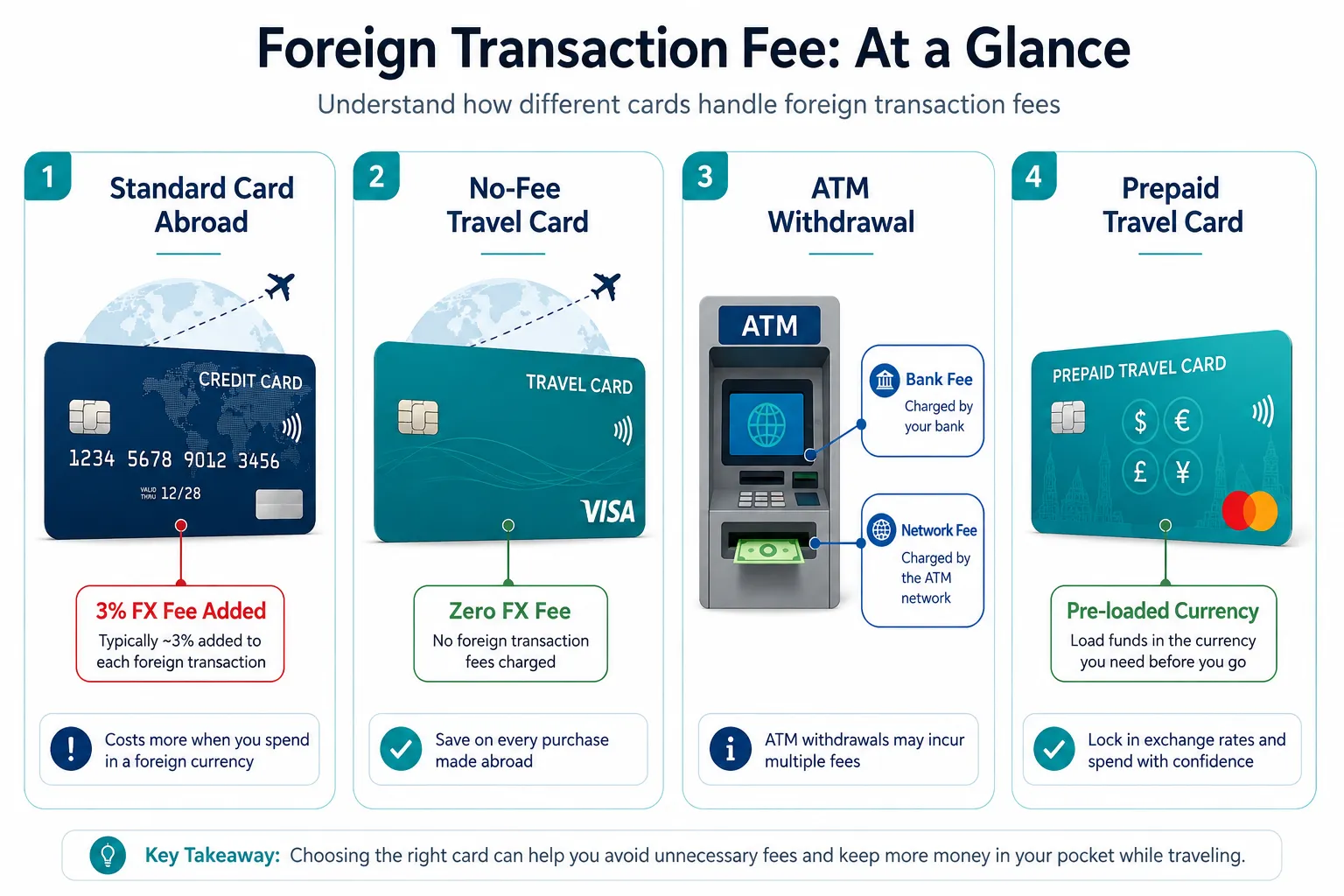
Foreign transaction fees are surcharges that banks and card networks add to purchases made in a foreign currency or processed through a non-U.S. bank. They typically range from 1% to 3% of each transaction and appear as a separate line item on your statement.
For a traveler spending $3,000 on a two-week trip to Europe, a 3% foreign transaction fee adds $90 in pure overhead. Over multiple trips per year, that figure compounds quickly. The fees apply not just to in-person purchases abroad but also to any online purchase billed in a foreign currency, which catches many travelers off guard.
Who this affects most:
- Frequent international travelers (business or leisure)
- Digital nomads making daily purchases abroad
- Online shoppers buying from foreign retailers
- Anyone booking hotels or tours directly with overseas vendors
How Much Do Foreign Transaction Fees Usually Cost
The standard foreign transaction fee is 2.7% to 3% on most mainstream U.S. credit cards and bank debit cards, according to the Consumer Financial Protection Bureau. Some cards charge as little as 1%, but any amount above zero is money lost on every single transaction.
Here is a realistic cost breakdown based on a $5,000 international travel budget:
| Fee Rate | Cost on $5,000 Spend |
|---|---|
| 3% (typical bank card) | $150 |
| 2% (some mid-tier cards) | $100 |
| 1% (low-fee cards) | $50 |
| 0% (no-fee travel cards) | $0 |
The math is straightforward: choosing the right card before you travel is one of the easiest ways to keep more money in your pocket without changing any spending behavior.
Best Credit Cards with No Foreign Transaction Fees 2026
The best travel credit and debit cards with zero foreign transaction fees in 2026 cover a range of annual fees and reward structures, so there is a strong option for every type of traveler.
Chase Sapphire Preferred
Annual fee: $95
Rewards: 3x on dining, 2x on travel, 1x on everything else
Foreign transaction fee: None
The Chase Sapphire Preferred remains one of the most recommended entry-level travel cards for 2026. Points transfer to over a dozen airline and hotel partners at a 1:1 ratio, and the card carries strong travel protections including trip cancellation insurance and primary car rental coverage.
Choose this if: You want a mid-range annual fee card with flexible points and broad travel protections.
Capital One Venture X
Annual fee: $395
Rewards: 10x on hotels and rental cars via Capital One Travel, 5x on flights, 2x on all other purchases
Foreign transaction fee: None
The Venture X earns flat-rate miles on every purchase and includes a $300 annual travel credit plus Priority Pass lounge access. For travelers who spend more than $400 per year on lounge access and travel, the annual fee is effectively offset.
Choose this if: You want premium perks at a lower annual fee than the Amex Platinum.
American Express Platinum
Annual fee: $695
Rewards: 5x on flights booked directly with airlines or through Amex Travel, 5x on prepaid hotels via Amex Travel
Foreign transaction fee: None
The Amex Platinum targets high-frequency travelers. Its credits (up to $200 airline fee, $200 hotel, $240 digital entertainment, and others) can offset the annual fee for heavy users. Acceptance can be lower in some regions, particularly rural Asia and parts of Eastern Europe.
Choose this if: You travel frequently, value lounge access heavily, and will actually use the statement credits.
Discover it Miles
Annual fee: $0
Rewards: 1.5x miles on all purchases, doubled at the end of the first year
Foreign transaction fee: None
Discover waives foreign transaction fees and charges no annual fee, making it the best zero-cost option. The main limitation is acceptance: Discover has limited acceptance in parts of Asia, the Middle East, and smaller European countries.
Choose this if: You want a no-annual-fee backup card or are a light international traveler.
Capital One VentureOne
Annual fee: $0
Rewards: 1.25x miles on all purchases
Foreign transaction fee: None
A solid no-annual-fee option with no foreign transaction fees. Rewards are modest compared to premium cards, but for occasional travelers, the lack of any annual cost makes it a practical choice.
Do Debit Cards Have Foreign Transaction Fees
Most standard bank debit cards do charge foreign transaction fees, typically between 1% and 3%, plus a flat ATM withdrawal fee of $2 to $5 per transaction. However, several debit cards specifically designed for travelers waive these charges entirely.
Best no-fee debit cards for international travel:
- Charles Schwab Bank Debit Card: No foreign transaction fees, and Schwab reimburses all ATM fees worldwide at the end of each month. This is widely considered the gold standard for travel debit cards in 2026.
- Wise Debit Card: Converts currency at the mid-market exchange rate with a small conversion fee (typically 0.35% to 1.75% depending on currency), but no foreign transaction fee. Excellent for holding and spending multiple currencies.
- Revolut (Standard tier): No foreign transaction fees on weekday transactions up to a monthly limit. Weekend transactions may carry a small markup.
- Fidelity Cash Management Account Debit Card: No foreign transaction fees and ATM fee reimbursements worldwide.
Common mistake: Many travelers assume their regular bank debit card is fee-free abroad because it has no annual fee. Always check the card’s fee schedule specifically for “foreign transaction” or “international purchase” fees before traveling.
Which Travel Credit Cards Have the Lowest Annual Fees
For travelers who want no foreign transaction fees without paying a high annual fee, the best options in 2026 are the Capital One VentureOne ($0), Discover it Miles ($0), and Chase Sapphire Preferred ($95).
| Card | Annual Fee | Foreign Transaction Fee | Best For |
|---|---|---|---|
| Capital One VentureOne | $0 | None | Occasional travelers |
| Discover it Miles | $0 | None | Light travelers, first-year bonus |
| Bank of America Travel Rewards | $0 | None | BofA banking customers |
| Chase Sapphire Preferred | $95 | None | Mid-tier rewards seekers |
| Capital One Venture X | $395 | None | Premium perks, frequent travelers |
| Amex Platinum | $695 | None | High-frequency luxury travelers |
The $0 annual fee cards are best for people who travel two to four times per year. If you travel more often, the rewards and perks on mid-tier cards like the Chase Sapphire Preferred typically outweigh the $95 annual fee within the first few months of use.
Chase Sapphire vs Amex Platinum Foreign Transaction Fees
Both the Chase Sapphire Preferred and the American Express Platinum charge zero foreign transaction fees, so neither card penalizes you for spending abroad. The key differences come down to annual fee, acceptance, and rewards structure.
Chase Sapphire Preferred vs. Amex Platinum, quick comparison:
- Annual fee: $95 (Sapphire Preferred) vs. $695 (Amex Platinum)
- Acceptance abroad: Visa (Sapphire) is accepted at more locations globally than Amex, particularly in Asia, rural Europe, and developing markets
- Rewards on travel: 2x (Sapphire Preferred) vs. 5x on flights (Amex Platinum)
- Lounge access: None standard (Sapphire Preferred) vs. Centurion, Priority Pass, and Delta Sky Clubs (Amex Platinum)
- Travel protections: Both offer trip cancellation and interruption insurance; Chase includes primary rental car coverage
Decision rule: Choose the Sapphire Preferred if you want strong travel protections and broad acceptance at a low annual fee. Choose the Amex Platinum only if you will use enough of its credits and lounge access to justify the $695 annual fee.
Can You Use Regular Credit Cards Abroad Without Extra Charges
Standard credit cards almost always add a foreign transaction fee of 1% to 3% on international purchases. Unless your card’s terms explicitly state “no foreign transaction fees,” assume you will be charged.
How to check your card:
- Log in to your card’s online portal and search for “foreign transaction fee” in the fee schedule.
- Call the number on the back of your card and ask directly.
- Check the Schumer Box (the standardized fee table) in your original card agreement.
Some cards marketed as “travel cards” still carry foreign transaction fees, so the label alone is not reliable. Always verify before departure.
Edge case: Even with a no-fee card, merchants abroad may offer to charge you in your home currency (dynamic currency conversion). Always decline and pay in the local currency, DCC rates are typically 3% to 7% worse than the standard exchange rate, and your no-fee card cannot protect you from a conversion you agree to at the terminal.
Best Travel Cards for Europe vs Asia
The best travel credit and debit cards with zero foreign transaction fees perform differently depending on the region, primarily due to card network acceptance and local payment infrastructure.
For Europe:
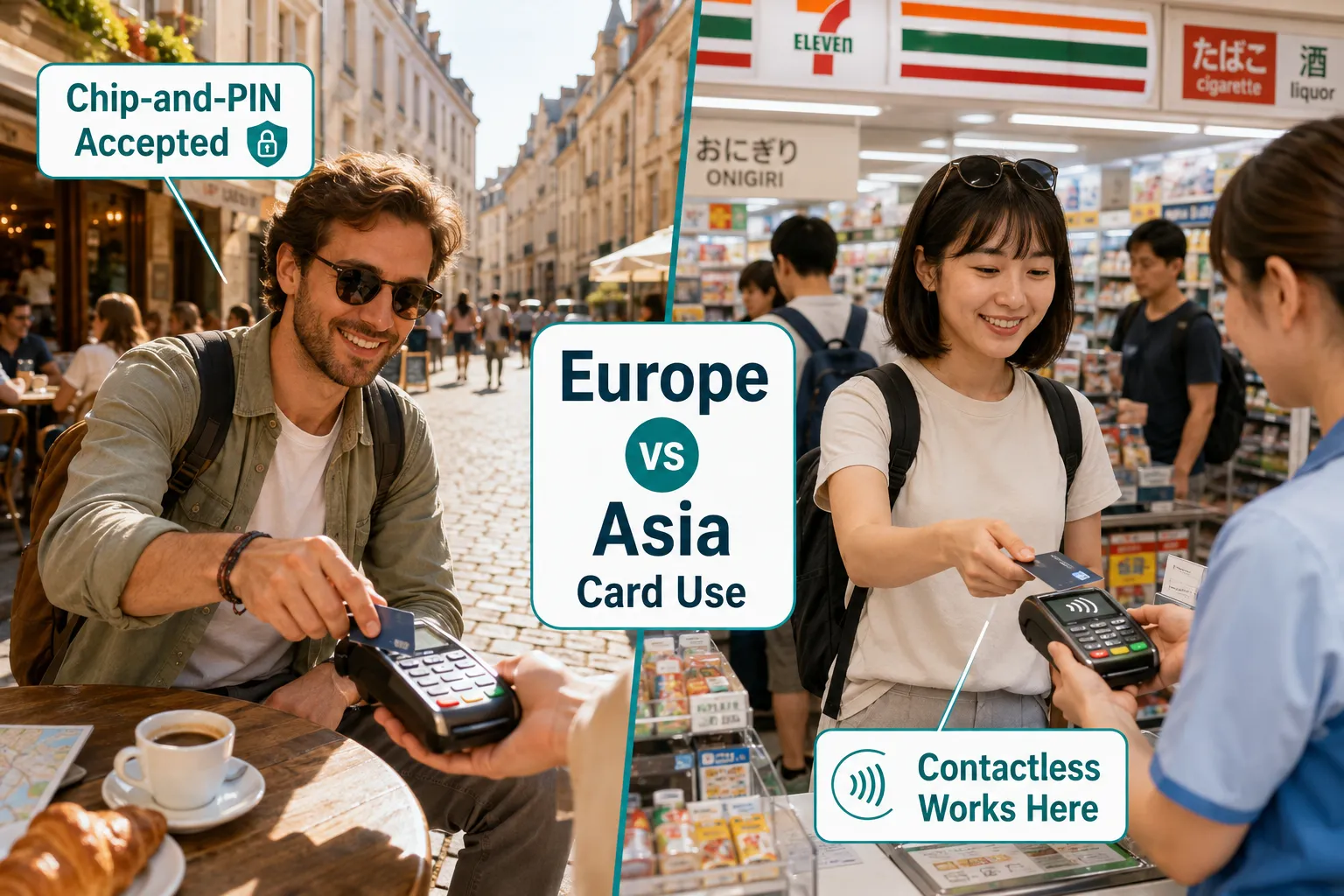
- Visa and Mastercard are accepted almost universally, including in smaller towns and rural areas.
- Chip-and-PIN is standard; contactless is widely available.
- Best cards: Chase Sapphire Preferred (Visa), Capital One Venture X (Visa), Charles Schwab Debit (Visa).
- American Express acceptance has improved in major cities but remains limited in smaller towns.
For Asia:
- Japan, South Korea, and Singapore have strong card acceptance in urban areas, but cash remains important in rural Japan. For budget travel planning in Japan, the cheapest ways to travel around Kyushu Japan in 2026 guide covers when cash is essential versus when cards work.
- Southeast Asia (Thailand, Vietnam, Cambodia) is more cash-dependent outside tourist zones.
- Visa and Mastercard work best. Discover and Amex have patchy acceptance.
- Best cards: Any Visa or Mastercard with no foreign transaction fees plus a fee-free debit card for ATM withdrawals.
For the Middle East (including Oman):
- Visa and Mastercard are widely accepted in cities. If you are planning a trip to Oman, pairing your travel card with a reliable data connection matters too, see the best eSIM cards for Oman travel for connectivity options alongside your payment setup.
Practical rule: Carry one Visa or Mastercard with no foreign transaction fees as your primary card, and one fee-free debit card for cash withdrawals. This combination covers nearly every destination worldwide.
How to Avoid ATM Fees When Traveling Internationally
International ATM fees have two components: a fee from your own bank and a fee from the foreign ATM operator. The best no-fee debit cards eliminate your bank’s fee and reimburse the ATM operator’s fee.
Step-by-step approach to avoiding ATM fees abroad:
- Open a Charles Schwab Bank checking account before your trip. Schwab reimburses all ATM fees worldwide, with no cap.
- As a backup, use a Wise account loaded with local currency. Wise allows two free ATM withdrawals per month up to $100 each.
- At the ATM, always select “withdraw in local currency” and decline any offered conversion.
- Use ATMs attached to major banks rather than standalone machines in airports or tourist areas, which charge higher operator fees.
- Withdraw larger amounts less frequently to minimize per-transaction costs even when fees do apply.
Common mistake: Using your regular debit card at an international ATM and being charged $5 by your bank plus $3 to $5 by the ATM operator, a $8 to $10 fee on a $100 withdrawal is effectively an 8-10% surcharge.
Do Prepaid Travel Cards Have Foreign Transaction Fees
Prepaid travel cards vary widely. Some charge no foreign transaction fees but offset this with loading fees, inactivity fees, or poor exchange rates. Others are genuinely cost-effective for specific use cases.
Prepaid cards worth considering:
- Wise Prepaid Debit Card: No foreign transaction fee. Converts at the mid-market rate with a transparent conversion fee. Best for multi-currency travelers who want to pre-load specific currencies.
- Revolut Prepaid Card: No foreign transaction fee on weekday transactions within monthly limits on the free tier. Weekend transactions carry a 1% markup.
Prepaid cards to avoid: Generic bank-issued prepaid travel cards from major U.S. banks often charge a 1-3% load fee, a monthly maintenance fee, and a foreign transaction fee on top of a poor exchange rate.
Decision rule: Use a prepaid card only if you want to cap your spending or need to hold a specific foreign currency in advance. For most travelers, a no-fee credit card plus a Charles Schwab debit card is more cost-effective than any prepaid card.
Travel Credit Cards for People with Fair Credit
People with fair credit (typically a FICO score of 580-669) have fewer options but are not locked out of no-foreign-transaction-fee cards entirely.
Best options for fair credit:
- Capital One VentureOne: Capital One is known for approving applicants with fair credit on some of its products. No foreign transaction fees and no annual fee.
- Discover it Miles: Discover considers applicants with fair credit and offers a path to a better card after responsible use. No foreign transaction fees, no annual fee.
- Secured travel cards: Some secured cards, such as the Discover it Secured, have no foreign transaction fees and help build credit toward an upgrade.
What to avoid: Applying for premium cards like the Chase Sapphire Preferred or Amex Platinum with fair credit. Hard inquiries from declined applications temporarily lower your score further.
Practical step: Use a no-fee secured or entry-level card for 12-18 months, pay the balance in full each month, and then apply for a mid-tier travel card once your score moves into the good range (670+).
What Happens If Your Card Gets Declined Abroad
A card decline abroad is more common than most travelers expect and rarely means fraud. The most frequent causes are a bank’s fraud detection system flagging unusual international activity, a chip-and-PIN requirement the card cannot meet, or a merchant’s terminal not accepting your card network.
Immediate steps when a card is declined abroad:
- Try a different card, this is why carrying two cards from different networks (Visa and Mastercard, or Visa and a debit card) is essential.
- Check your phone for a fraud alert text or email from your bank. Many banks now send real-time alerts and allow you to approve the transaction instantly through their app.
- Call the number on the back of your card if no alert appears. Most major U.S. banks have 24/7 international customer service lines.
- Use a local ATM to withdraw cash as a short-term backup.
Prevention: Notify your bank of travel dates before departure, even if the bank says it is no longer required. Some banks still flag unusual international activity, and a quick notification prevents most declines.
Best Travel Cards If You Don’t Fly Much
No-foreign-transaction-fee cards are valuable even for travelers who rarely fly. The best options for non-frequent flyers focus on cash back or flexible rewards rather than airline miles that are hard to redeem without regular flying.
Best picks for non-flyers:
- Capital One VentureOne: Miles redeem as statement credits against any travel purchase, including hotels, rental cars, and train tickets. No airline loyalty required.
- Discover it Miles: Miles convert to cash back at the same value, so there is no pressure to redeem for flights.
- Charles Schwab Debit Card: No rewards, but zero fees on every international transaction and ATM reimbursements make it a practical daily card for road trippers and cruise travelers.
For travelers exploring budget destinations by road or rail, the combination of a no-fee card and careful budget planning makes a significant difference. The Albania 7-day road trip cost guide is a good example of how card fees (or the lack of them) factor into a real travel budget.
Do Travel Rewards Cards Actually Save You Money on Fees
Yes, but the savings depend on how you use the card. A no-foreign-transaction-fee card saves money passively on every international purchase. Rewards on top of that are a bonus, not the primary financial benefit.
Realistic savings example for a traveler spending $6,000 abroad per year:
- Foreign transaction fee savings (3% avoided): $180
- Rewards earned at 2x on travel (value varies, but roughly 1-2 cents per point): $120-$240
- Total annual benefit: $300-$420 before subtracting any annual fee
For a card with a $95 annual fee, the net benefit is still $205-$325. For a $0 annual fee card, the full amount is retained.
Where rewards cards fail to save money:
- Carrying a balance. Interest charges at 20%+ APR eliminate any rewards benefit immediately.
- Paying a high annual fee without using the card’s credits or perks.
- Redeeming points for low-value options like merchandise or gift cards instead of travel.
Bottom line: A no-foreign-transaction-fee card saves money on every trip regardless of rewards. Rewards amplify the benefit for cardholders who pay in full each month. For more travel budgeting resources, the RoamBudget blog covers cost breakdowns across a range of destinations.
Frequently Asked Questions
Q: What is the easiest no-foreign-transaction-fee card to get approved for?
The Discover it Miles and Capital One VentureOne are the most accessible no-foreign-transaction-fee cards for applicants without excellent credit. Both have no annual fee and consider applicants with fair credit histories.
Q: Does the Chase Sapphire Preferred charge foreign transaction fees?
No. The Chase Sapphire Preferred charges zero foreign transaction fees on all international purchases. This applies to in-person transactions abroad and online purchases billed in a foreign currency.
Q: Is Wise better than a travel credit card for international spending?
Wise is better for currency conversion at the mid-market rate, especially for currencies where credit card networks add a spread. However, Wise does not offer rewards, travel insurance, or purchase protections. Most travelers benefit from using both: a no-fee credit card for purchases and Wise or Charles Schwab for ATM withdrawals.
Q: Can I use Apple Pay or Google Pay abroad with a no-fee card?
Yes. Digital wallet transactions use the underlying card’s terms. If the card has no foreign transaction fee, that applies whether you tap your phone or swipe the physical card.
Q: Do no-foreign-transaction-fee cards also waive currency conversion fees?
Not always. “No foreign transaction fee” means the card issuer does not add a surcharge. The card network (Visa, Mastercard) still applies its own exchange rate, which is typically close to the mid-market rate and far better than airport exchange counters or dynamic currency conversion. Wise and Revolut use the actual mid-market rate, which can be marginally better for some currency pairs.
Q: What is dynamic currency conversion and should I avoid it?
Dynamic currency conversion (DCC) is when a foreign merchant or ATM offers to charge you in your home currency instead of the local currency. The conversion rate used is typically 3-7% worse than the standard rate. Always decline DCC and pay in the local currency, even if you have a no-foreign-transaction-fee card.
Q: How many travel cards should I carry internationally?
Carry at least two: one no-fee credit card (Visa or Mastercard) for purchases and one no-fee debit card (Charles Schwab or Wise) for ATM withdrawals. Store them separately in case one is lost or stolen.
Q: Does the Amex Platinum work everywhere internationally?
No. American Express has lower acceptance than Visa or Mastercard in many regions, including rural Japan, Southeast Asia, Eastern Europe, and parts of Latin America. Always carry a Visa or Mastercard as a backup when traveling with an Amex.
Conclusion
Eliminating foreign transaction fees is one of the simplest and most impactful changes a traveler can make before any international trip. The best travel credit and debit cards with zero foreign transaction fees in 2026 span every budget and credit profile, from the $0 annual fee Discover it Miles to the premium Capital One Venture X.
Actionable next steps:
- Check your current card’s fee schedule today. If it charges a foreign transaction fee, apply for a replacement before your next trip.
- Open a Charles Schwab Bank checking account for fee-free ATM withdrawals worldwide.
- If you have fair credit, start with the Capital One VentureOne or Discover it Miles and build toward a mid-tier card.
- Always pay in local currency at checkout to avoid dynamic currency conversion.
- Carry one Visa or Mastercard credit card and one fee-free debit card as your standard international travel setup.
The right card combination costs nothing extra to carry and saves real money on every trip. There is no reason to pay foreign transaction fees in 2026.