Last updated: August 14, 2026
Disclaimer: This post contains affiliate links. We may earn a commission if you make a purchase through our links, at no extra cost to you.
Quick Answer
The cheapest unlimited data eSIMs for international travel in 2026 start at roughly $15 to $25 per month for regional plans, with providers like Airalo, Holafly, and Nomad leading on price and coverage. Most “unlimited” plans throttle speeds after 1 GB to 10 GB of high-speed data. Always check the fair-use cap before buying.
Key Takeaways
- True unlimited eSIM plans with no throttling are rare. Most cap high-speed data at 1 GB to 20 GB, then drop to 128 Kbps to 512 Kbps.
- Airalo, Holafly, Nomad, Ubigi, and Saily are the most competitive providers for budget international travelers in 2026.
- Regional eSIM plans (covering Europe, Asia, or the Americas) cost less per day than single-country plans.
- Your phone must be unlocked and eSIM-compatible. Most flagship phones from 2020 onward support eSIM.
- Activation requires a Wi-Fi connection and a QR code scan or manual entry of carrier credentials.
- Europe has the densest eSIM coverage. Southeast Asia and South America have improving but patchier networks.
- Hidden fees include roaming surcharges when crossing plan boundaries, auto-renewal charges, and data add-on costs.
- Digital nomads benefit most from monthly global plans. Occasional travelers save more with short-trip regional plans.
- You can hold multiple eSIM profiles on one phone and switch between them without removing a physical SIM.
- Speed tests from independent travelers consistently show 4G LTE averages of 20 Mbps to 50 Mbps on top-tier eSIM plans in urban areas.
What Is an eSIM and How Does It Work for Travel
An eSIM (embedded SIM) is a digital SIM card built directly into your phone’s hardware. Instead of inserting a plastic card, you download a carrier profile over Wi-Fi and activate it within minutes. For international travel, this means you can switch to a local or regional data plan before you even board your flight.
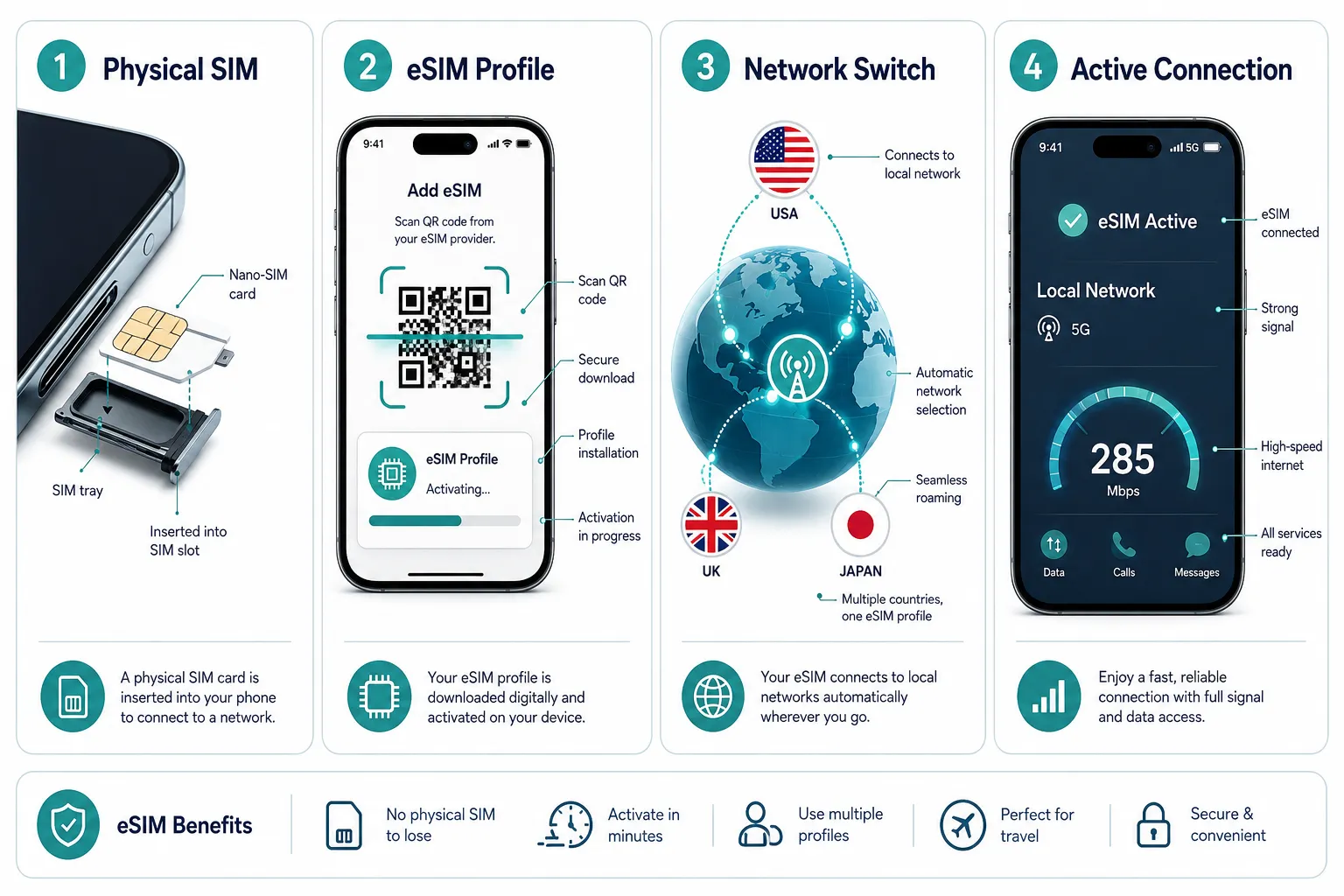
Here is how the process works in practice:
- Purchase a plan from an eSIM provider (Airalo, Holafly, Nomad, etc.) through their app or website.
- Receive a QR code via email or in-app.
- Scan the QR code in your phone’s SIM/eSIM settings while connected to Wi-Fi.
- Set the eSIM as your data line and keep your home SIM active for calls and texts if needed.
- Arrive at your destination with data already working.
The eSIM profile connects to local partner networks in each country. Your phone selects the strongest available signal automatically, just as it would with a physical SIM.
Edge case: Some older carrier-locked phones block eSIM installation even if the hardware supports it. Always confirm your device is carrier-unlocked before purchasing.
Best Unlimited Data eSIMs for International Travel 2026
The best options for cheapest unlimited data eSIMs for international travel balance price, coverage breadth, and honest throttling policies. No single provider wins across every region, so the right choice depends on where you are going and how long you will stay.
Airalo
Airalo is the largest eSIM marketplace, offering plans from over 200 countries and regions. Regional “Unlimited” plans for Europe start around $17 for 7 days. Airalo partners with local carriers in each country, so network quality varies by destination. High-speed data caps typically range from 1 GB to 5 GB depending on the plan tier.
- Best for: Budget travelers, short trips, wide destination coverage
- Weakness: Customer support response times can be slow
Holafly
Holafly markets itself as a true unlimited provider with no data caps on many plans. Prices run higher than Airalo, starting around $27 for 7 days in Europe, but the absence of a hard speed cap is a real advantage for video-heavy users. Holafly uses a single-device restriction, meaning the hotspot/tethering feature is blocked on most plans.
- Best for: Travelers who stream video or use video calls frequently
- Weakness: No tethering on most plans; higher price point
Nomad
Nomad offers competitive regional plans with clear fair-use policies. A 10 GB plan for Asia-Pacific runs approximately $18 to $22 for 30 days. Nomad’s app is well-reviewed for ease of activation and plan management.
- Best for: Mid-length trips to Asia and the Pacific
- Weakness: Smaller coverage footprint than Airalo
Ubigi
Ubigi (owned by Transatel, a NTT DATA company) focuses on business and frequent travelers. Plans cover 190-plus countries, and tethering is permitted. Monthly global plans start around $40 to $50 for 10 GB.
- Best for: Digital nomads and business travelers who need hotspot capability
- Weakness: Higher cost for casual travelers
Saily
Saily, launched by the team behind NordVPN, entered the eSIM market in 2023 and has grown quickly. Regional plans for Europe start around $14 to $18 for 7 days. Coverage quality is solid in Western Europe but thinner in Eastern Europe and Central Asia.
- Best for: Privacy-conscious travelers who already use Nord products
- Weakness: Newer provider with a shorter track record
How Much Does an Unlimited Data eSIM Actually Cost
Prices for unlimited data eSIMs for international travel vary significantly by region, duration, and what “unlimited” actually means in the fine print. Here is a realistic pricing overview based on publicly listed rates in 2026:
| Provider | Region | Duration | Est. Price (USD) | High-Speed Cap |
|---|---|---|---|---|
| Airalo | Europe | 7 days | ~$17 | 1-3 GB |
| Holafly | Europe | 7 days | ~$27 | None stated |
| Nomad | Asia-Pacific | 30 days | ~$20 | 10 GB |
| Ubigi | Global | 30 days | ~$45 | 10 GB |
| Saily | Europe | 7 days | ~$15 | 3-5 GB |
Prices are estimates based on publicly listed rates as of mid-2026 and may change. Always verify on the provider’s website before purchasing.
Key cost insight: Regional plans cost 30% to 50% less per day than single-country plans for the same provider. If you are visiting multiple countries in one trip, always choose a regional plan.
eSIM vs Physical SIM for Traveling Abroad
An eSIM is faster to set up, eliminates the risk of losing a small plastic card, and lets you keep your home number active simultaneously. A physical SIM is better for older devices, countries with limited eSIM partner networks, or situations where you need to hand a SIM to someone else.
Choose an eSIM if:
- Your phone is unlocked and eSIM-compatible (most flagships from 2020 onward)
- You want to activate a plan before departure
- You are visiting multiple countries on one trip
- You want to avoid airport SIM kiosks and their inflated prices
Choose a physical SIM if:
- Your phone is older or carrier-locked
- You are staying in one country for a month or more and want a local prepaid plan
- You need to share the SIM with a travel companion’s device
For destinations like Japan, where local SIM cards offer excellent value, pairing an eSIM for data with a local physical SIM for calls can be a smart hybrid approach. For more on budget connectivity while traveling in Japan, see Cheapest Ways to Travel Around Kyushu Japan in 2026.
Do Unlimited eSIMs Really Throttle After Certain Usage
Yes, nearly all “unlimited” eSIM plans throttle speeds after a defined high-speed data threshold. This is the single most important thing to understand before buying any unlimited plan. After the cap is reached, speeds typically drop to 128 Kbps to 512 Kbps, which is enough for basic messaging but not for video calls or streaming.
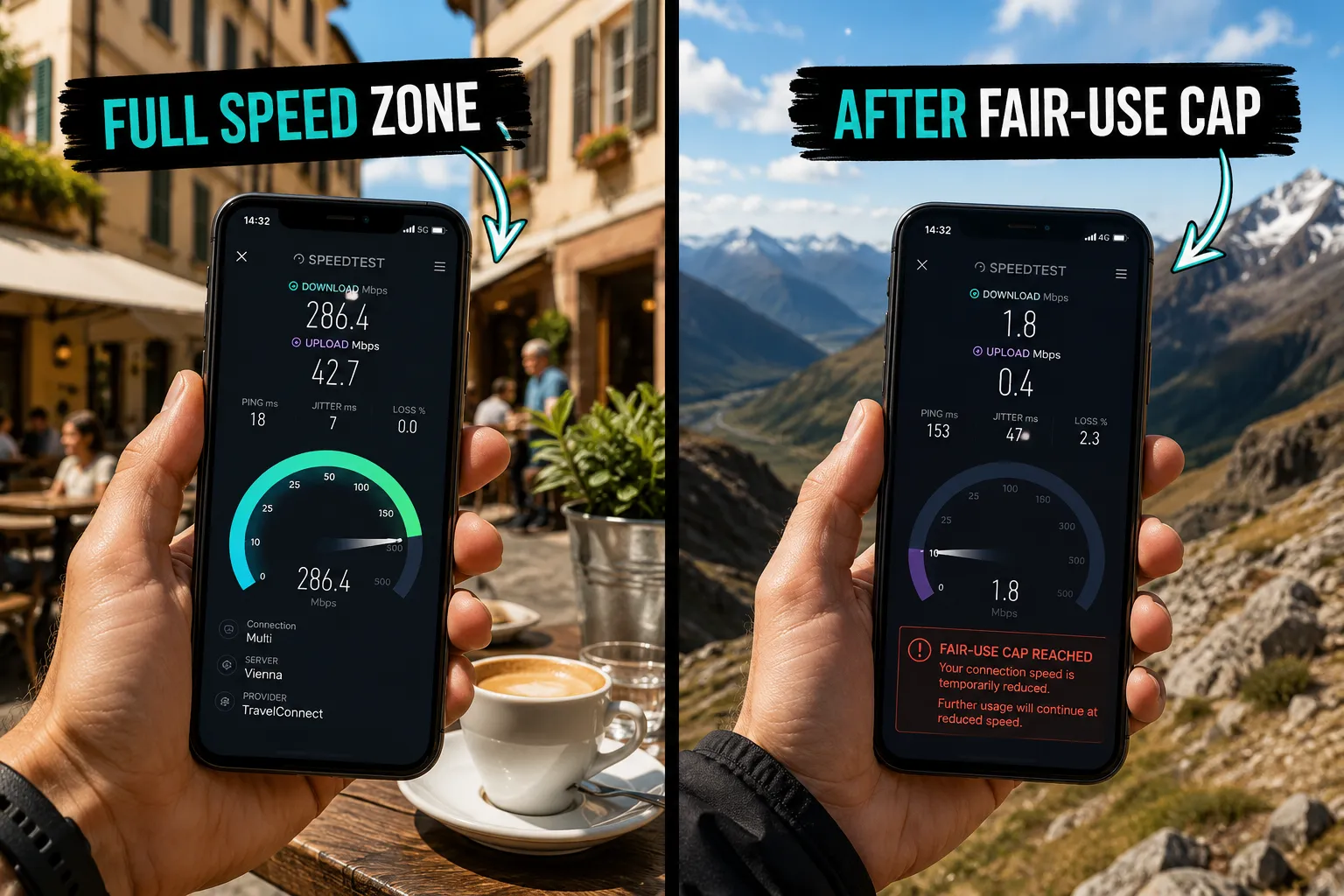
How throttling works in practice:
- Holafly does not publish a hard GB cap on many plans but reserves the right to throttle users who consume “excessive” data, which is generally interpreted as more than 10 GB to 15 GB per day.
- Airalo’s “unlimited” plans are more transparent: they list the high-speed data allowance (e.g., 3 GB at full speed, then throttled).
- Nomad and Ubigi clearly state the data cap before purchase, making them easier to evaluate honestly.
Common mistake: Travelers assume “unlimited” means full-speed unlimited. Read the fair-use policy on every plan page before purchasing. Look for the phrase “high-speed data” followed by a GB number.
“Unlimited data” in the eSIM market almost always means unlimited throttled data after a fixed high-speed allowance. The high-speed cap is the number that actually matters for your daily usage.
Cheapest eSIM for Europe vs Asia vs South America
The cheapest unlimited data eSIMs for international travel differ by region because network infrastructure, carrier partnerships, and regulatory environments vary widely.
Europe
Europe has the most competitive eSIM market. Multiple providers offer 7-day regional plans covering 30 to 50 countries for $14 to $27. Saily and Airalo are the cheapest entry points. Network quality is consistently 4G LTE in Western Europe, with 5G available in major cities.
Asia
Southeast Asia is well-served by Nomad, Airalo, and Klook eSIM. Plans covering 10 to 15 Asian countries for 30 days run $18 to $30. Japan, South Korea, and Singapore have excellent 5G coverage. Remote areas of Indonesia, Vietnam, and the Philippines can have patchy 3G signals regardless of provider.
For travelers planning a trip to the Middle East alongside Asia, the Best eSIM Cards for Oman Travel: 2026 Price Comparison guide covers regional options in detail.
South America
South America is the most challenging region for eSIM coverage. Brazil, Argentina, Colombia, and Chile have reasonable 4G LTE coverage in cities, but rural areas are poorly served. Regional South America eSIM plans from Airalo or Nomad run $20 to $35 for 30 days. Expect more frequent network switching and occasional dead zones.
Decision rule: For Europe, prioritize price and plan duration. For Asia, prioritize carrier partnerships in your specific countries. For South America, prioritize plans with the most local carrier agreements rather than the cheapest headline price.
Which Countries Have the Fastest eSIM Coverage
South Korea, Japan, the UAE, and the Netherlands consistently rank among the fastest mobile networks in the world, according to Ookla’s Speedtest Global Index (2024). eSIM users in these countries can expect median download speeds of 100 Mbps to 300 Mbps on 5G-enabled plans.
Fastest eSIM network performance by region (estimated medians on 4G LTE):
- South Korea: 80-150 Mbps download
- Japan: 60-120 Mbps download
- UAE: 70-130 Mbps download
- Germany: 40-80 Mbps download
- United States: 30-70 Mbps download
- Brazil (urban): 20-40 Mbps download
- Indonesia (urban): 15-30 Mbps download
Source: Ookla Speedtest Global Index, 2024. Actual eSIM speeds depend on the specific carrier partner used by your eSIM provider in each country.
Edge case: An eSIM provider may advertise “5G capable” plans, but actual 5G access depends on whether their local carrier partner has 5G infrastructure in your specific city. In most countries outside East Asia and Western Europe, 4G LTE is the realistic expectation.
eSIM Speed Comparison Between Providers
Speed performance among eSIM providers is not determined by the eSIM platform itself but by which local carrier the provider partners with in each country. Holafly, Airalo, and Nomad all use local carrier networks, so a plan labeled “unlimited” from two different providers in the same country may actually run on the same underlying network.
What actually affects your speed:
- The local carrier partner (Tier 1 carriers like Vodafone, T-Mobile, or SingTel deliver faster speeds than smaller regional carriers)
- Whether the plan includes 5G or is capped at 4G LTE
- Network congestion at your location and time of day
- Whether you have hit the high-speed data cap
Provider speed reputation (based on community reports from Reddit r/eSIM and Trustpilot, 2024-2025):
- Holafly: Consistently strong in Europe and Latin America; variable in Asia
- Airalo: Strong in Asia and the Middle East; variable in Africa
- Nomad: Strong in Asia-Pacific; limited in Europe
- Ubigi: Reliable globally but not the fastest; best for consistent connectivity over peak speed
- Saily: Strong in Western Europe; limited data for other regions
Can You Use an eSIM on Any Phone
No. eSIM compatibility depends on both the device hardware and the carrier unlock status. Most flagship smartphones released from 2020 onward support eSIM, but budget Android devices and some regional market variants do not.
Confirmed eSIM-compatible device categories:
- iPhone XS and later (all models)
- Samsung Galaxy S20 and later (some regional variants excluded)
- Google Pixel 3a and later
- iPad Pro (2018 and later), iPad Air (2019 and later)
- Most recent MacBooks with Apple Silicon
Devices that do NOT support eSIM:
- Most budget Android phones under $200
- iPhones older than XS
- Some Samsung Galaxy models sold in China (hardware eSIM disabled)
- Carrier-locked devices that have not been unlocked by the original carrier
How to check: Go to Settings > General > About on iPhone, or Settings > Connections > SIM Manager on Android. If you see an “Add eSIM” or “Add Mobile Plan” option, your device supports it.
What Happens to Your eSIM When You Travel Between Countries
When you travel between countries within a regional plan’s coverage area, your eSIM automatically connects to the next country’s partner carrier without any action on your part. This is the main advantage of regional plans over single-country plans.
What changes when you cross a border:
- Your phone connects to the strongest available partner carrier in the new country
- Your data balance continues to draw from the same plan
- Call and text functions (if included) may change based on local carrier agreements
- In rare cases, there may be a brief connection gap of 1 to 5 minutes while the network registers
What does NOT change:
- Your eSIM profile stays installed; you do not need to reinstall or re-scan a QR code
- Your home SIM (if kept active in the second SIM slot) continues to work for your home number
Common mistake: Purchasing a single-country eSIM plan and then crossing into a neighboring country. Your data will stop working the moment you leave the plan’s coverage area. Always buy a regional plan if your itinerary spans multiple countries.
For travelers on a multi-country road trip, understanding connectivity across borders is as important as planning the route itself. The Albania 7-Day Road Trip Cost: Full Budget Guide 2026 is a useful reference for budget planning in a region where eSIM coverage can be uneven.
Hidden Fees in Unlimited eSIM Plans to Watch Out For
The advertised price of an eSIM plan rarely tells the full story. Several cost factors can inflate the real price of staying connected abroad.
Hidden fees and costs to check before purchasing:
- Auto-renewal charges: Some providers automatically renew your plan at full price when it expires. Disable auto-renewal in your account settings immediately after purchase.
- Data top-up costs: After hitting the high-speed cap, some providers charge $5 to $15 for an additional 1 GB to 3 GB of full-speed data.
- Tethering restrictions: Plans that prohibit hotspot use force you to buy a separate plan for your laptop or tablet. Holafly blocks tethering on most plans. Ubigi and Nomad generally permit it.
- Currency conversion fees: Prices listed in USD may be charged in a different currency by your card issuer, adding 1% to 3% in conversion fees. Use a fee-free travel card like Revolut or Wise to avoid this.
- Plan expiry on activation vs purchase: Some plans start counting down from the moment you scan the QR code, not from when you arrive at your destination. Others start on first use. This distinction can cost you days of paid coverage.
Decision rule: Always read the FAQ section of the provider’s plan page, not just the headline price. Search specifically for “tethering,” “hotspot,” “auto-renewal,” and “activation date” before completing your purchase.
eSIM for Occasional Travelers vs Digital Nomads
The right eSIM strategy differs significantly depending on how often and how long you travel.
Occasional travelers (1 to 3 trips per year):
- Best approach: Buy a short-term regional plan per trip from Airalo or Saily
- Cost: $15 to $30 per trip
- Priority: Low price, easy activation, no long-term commitment
Frequent travelers (monthly international trips):
- Best approach: Use Airalo’s Discover+ global plan or Nomad’s multi-region bundles
- Cost: $30 to $50 per month
- Priority: Coverage breadth, consistent speeds, reliable customer support
Digital nomads (living abroad full-time):
- Best approach: Combine a local physical SIM in your primary base country with a global eSIM like Ubigi for travel days
- Cost: $40 to $80 per month combined
- Priority: Tethering capability, monthly data volume, multi-device support
For nomads who track every dollar of their travel budget, the RoamBudget blog covers cost-optimization strategies across accommodation, transport, and connectivity.
How to Activate and Set Up an eSIM Before Traveling
Activating an eSIM takes 5 to 15 minutes and should be done at home before departure, not at the airport. The process is the same across most providers.
Step-by-step activation guide:
- Purchase your plan through the provider’s app or website.
- Receive your QR code via email or in-app notification.
- Connect your phone to Wi-Fi.
- On iPhone: Go to Settings > Cellular > Add eSIM > Use QR Code.
On Android: Go to Settings > Connections > SIM Manager > Add eSIM. - Scan the QR code. The carrier profile will download in 30 to 60 seconds.
- Label the new eSIM (e.g., “Europe Trip”) for easy identification.
- Set the eSIM as your primary data line, or leave it on standby until you land.
- Keep your home SIM active for calls and texts if your phone supports dual SIM.
Do you need Wi-Fi to activate an eSIM?
Yes. Initial eSIM activation requires a Wi-Fi or existing cellular data connection to download the carrier profile. Once activated, the eSIM works without Wi-Fi. This means you should activate your eSIM at home or at a hotel before you need it, not after you have already lost your previous data connection. Some providers allow you to delay activation until first use, which is the safest option if you are activating close to departure.
Frequently Asked Questions
What is the cheapest unlimited eSIM for international travel in 2026?
Saily and Airalo offer the lowest entry prices for regional unlimited plans, starting around $14 to $17 for 7-day Europe plans. For Asia, Nomad’s 30-day plans starting around $18 to $20 offer the best value per day. Always compare the high-speed data cap, not just the headline price.
Is Holafly actually unlimited with no throttling?
Holafly does not publish a hard GB cap on most plans, but its terms of service allow throttling for “excessive use.” In practice, most users report full speeds throughout normal travel usage. Heavy users consuming 15 GB or more per day may experience speed reductions. Tethering is blocked on most Holafly plans.
Can I use an eSIM and my regular SIM at the same time?
Yes, on dual-SIM phones. Most modern smartphones support one physical SIM and one eSIM simultaneously. You can keep your home number active on the physical SIM for calls and texts while using the eSIM for data abroad. Some phones support two eSIM profiles simultaneously, but only one can be active for data at a time.
How do I know if my phone is eSIM compatible?
On iPhone, go to Settings > General > About and look for “Digital SIM” or “EID” information. On Android, go to Settings > Connections > SIM Manager. If you see an option to add an eSIM or digital SIM, your device is compatible. Alternatively, check your phone model against the eSIM compatibility list on the Airalo or Holafly website.
What happens if my eSIM plan runs out of data while I am abroad?
You can purchase a top-up or a new plan through the provider’s app using Wi-Fi. Most providers allow instant plan activation on an existing eSIM profile. If you have no Wi-Fi access, you may be able to use a small amount of throttled data (if your plan includes it) to connect to the provider’s app and top up.
Are eSIM plans refundable if I cancel my trip?
Refund policies vary by provider. Airalo offers refunds if the eSIM has not been installed. Holafly’s refund policy is more restrictive. Always check the cancellation policy before purchase, especially for expensive long-duration plans.
Which eSIM provider has the best coverage in South America?
Airalo has the broadest carrier partnerships in South America. Holafly also covers the major South American countries. Neither provider offers the same network density as in Europe. For Brazil specifically, local providers like Claro or TIM offer better rural coverage than any international eSIM.
Can I use an eSIM for calls and texts, or only data?
Most travel eSIM plans are data-only. To make calls, you can use VoIP apps like WhatsApp, Skype, or Google Meet over the eSIM data connection. Some providers (including Ubigi) offer plans with voice calling, but these are less common and cost more.
Conclusion
Finding the cheapest unlimited data eSIMs for international travel in 2026 comes down to three decisions: which provider covers your destination, what the real high-speed data cap is, and whether tethering is included. No single provider wins every category, but the combination of Airalo for budget short trips, Holafly for data-heavy travel in Europe, and Ubigi for nomads who need hotspot capability covers most traveler profiles.
Actionable next steps:
- Check your phone’s eSIM compatibility before anything else.
- Map your itinerary and choose a regional plan rather than single-country plans wherever possible.
- Read the fair-use policy and look specifically for the high-speed data cap.
- Activate your eSIM at home over Wi-Fi, not at the airport.
- Disable auto-renewal immediately after purchase.
- Use a fee-free travel card (Revolut or Wise) to avoid currency conversion charges on your eSIM purchase.
The eSIM market is competitive and improving fast. Prices are falling, coverage is expanding, and throttling thresholds are rising. Travelers who compare plans carefully and understand what “unlimited” actually means in the fine print will consistently pay less and stay better connected than those who buy the first plan they see.