Last updated: August 14, 2026
Disclaimer: This post contains affiliate links. We may earn a commission if you make a purchase through our links, at no extra cost to you.
Quick Answer
The top 5 eSIM providers with unlimited hotspot sharing for remote workers in 2026 are Airalo, Holafly, Nomad, Ubigi, and Saily. Each offers plans that allow hotspot tethering, broad international coverage, and data speeds suitable for video calls and remote work. Holafly and Saily lead for true unlimited data, while Airalo and Nomad offer the widest country coverage.
Key Takeaways
- eSIMs are digital SIM cards that activate instantly via QR code and support multiple carrier profiles on one device.
- Hotspot sharing (tethering) lets you connect laptops, tablets, and other devices to your phone’s mobile data connection.
- Not all “unlimited” eSIM plans allow hotspot sharing, always verify before purchasing.
- Most unlimited eSIM plans throttle speeds after a high-speed data threshold (commonly 1-5 GB per day).
- Airalo covers 200+ countries; Holafly and Saily offer the most straightforward unlimited plans with hotspot included.
- Ubigi is the strongest choice for high-speed data in Europe and North America, with 5G support on select plans.
- Nomad offers competitive pricing for Asia-Pacific and North America corridors frequently used by digital nomads.
- eSIM hotspot speeds are generally sufficient for video calls, cloud work, and light streaming, but rarely match home fiber connections.
- Switching between eSIM providers takes under 5 minutes using your phone’s settings menu.
- Always check local regulations, a small number of countries restrict or block eSIM activation.
What Is an eSIM and How Does It Work
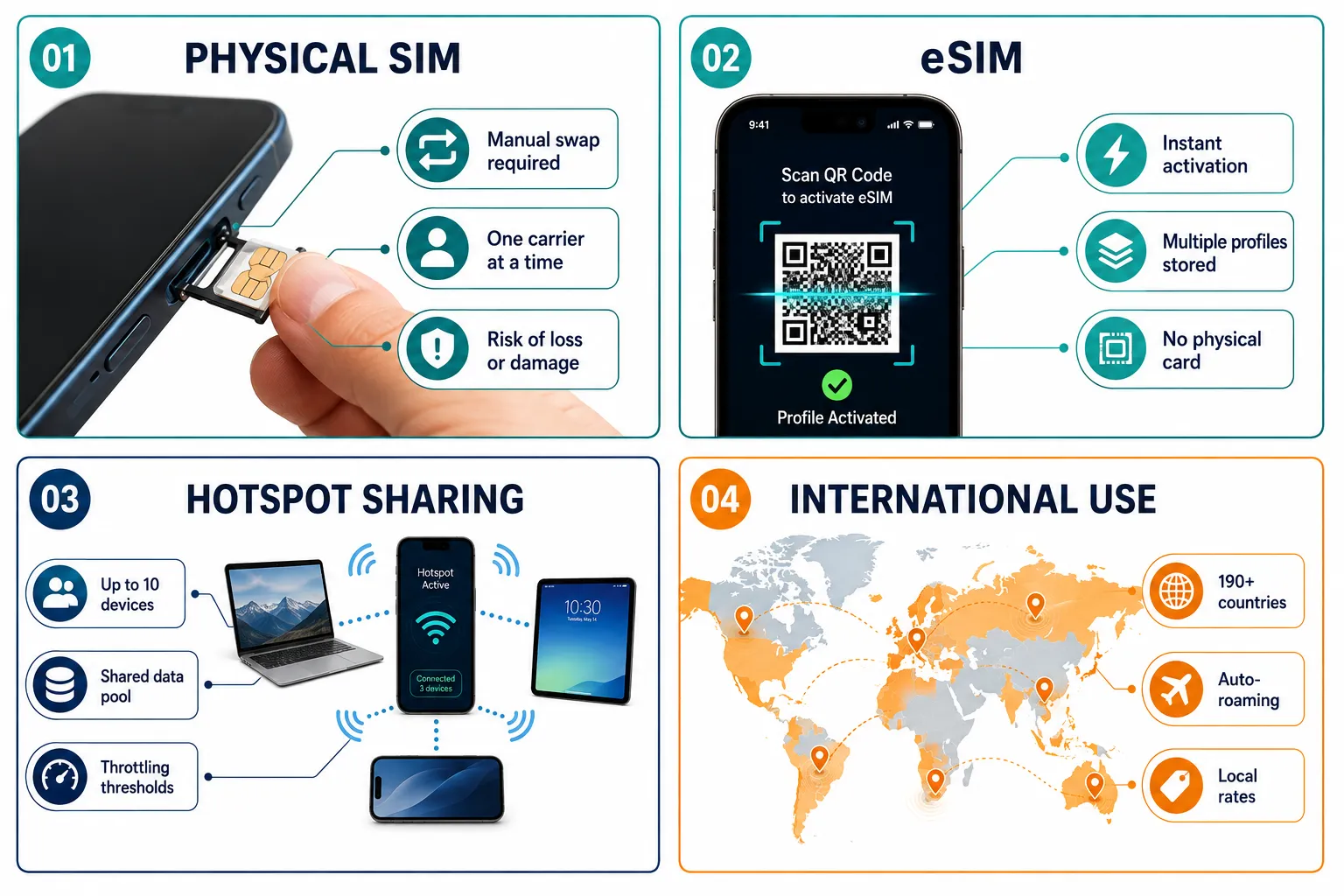
An eSIM (embedded SIM) is a digital version of the physical SIM card built directly into modern smartphones, tablets, and laptops. Instead of inserting a physical card, you download a carrier profile by scanning a QR code or using a provider’s app, and the connection activates within minutes.
Here is how the process works in practice:
- Purchase a plan from an eSIM provider online.
- Receive a QR code by email or in-app.
- Go to your phone’s settings (Settings > Cellular/Mobile > Add eSIM).
- Scan the QR code or enter the activation code manually.
- Toggle the eSIM profile on and set it as your data line.
- Enable the mobile hotspot feature to share data with other devices.
Most current flagship phones from Apple (iPhone XS and later), Samsung (Galaxy S20 and later), and Google (Pixel 3 and later) support eSIM. Devices must be carrier-unlocked to use third-party eSIM providers.
Key advantage for remote workers: You can store multiple eSIM profiles on one device and switch between them without touching a physical card. This is especially useful when crossing borders or comparing data costs between providers mid-trip.
eSIM vs Physical SIM for Remote Work
For remote workers, eSIM is the more practical choice in most situations. Physical SIMs require finding a local store, waiting in line, and sometimes providing local ID, all of which cost time. eSIMs activate instantly from anywhere with an internet connection.
When a physical SIM still makes sense:
- You are in a country with limited eSIM carrier support (some parts of Sub-Saharan Africa and Central Asia).
- Your device is not eSIM-compatible.
- You need a local phone number for two-factor authentication tied to a specific country.
When eSIM wins:
- You move between countries frequently.
- You need to activate data before landing (useful at airports).
- You want to keep your home SIM active while using a local data plan.
A remote worker traveling through Southeast Asia, for example, can pre-load an Airalo regional plan before departure, activate it on the plane, and have working data the moment they land, no SIM hunting required.
Top 5 eSIM Providers with Unlimited Hotspot Sharing for Remote Workers
These five providers stand out in 2026 for combining unlimited or high-volume data plans with confirmed hotspot sharing support. Each has been selected based on coverage breadth, hotspot policy transparency, speed performance, and customer support quality.
Airalo
Best for: Widest country coverage, flexible data packages.
Airalo is the largest eSIM marketplace, offering plans from local and regional carriers across 200+ countries. Most Airalo plans support hotspot sharing, though this depends on the underlying carrier for each region, always check the plan details page before purchasing.
- Coverage: 200+ countries and regions
- Hotspot sharing: Supported on most plans (carrier-dependent)
- Data type: Mostly capped plans (1 GB to 20 GB); unlimited options available in select regions
- Standout feature: “Esimgo” and “Flexiroam” base carriers on many plans offer solid mid-range speeds
- App quality: Clean, easy to manage multiple profiles
Choose Airalo if you travel across many different countries and want one app to manage all your eSIM plans.
Holafly
Best for: True unlimited data with hotspot included.
Holafly offers unlimited data plans in 160+ destinations and explicitly states that hotspot tethering is included on most of its plans. This makes it one of the clearest choices for remote workers who need to connect a laptop without worrying about a data cap.
- Coverage: 160+ countries
- Hotspot sharing: Confirmed included on most unlimited plans
- Data type: Unlimited (speeds throttled after daily fair-use threshold, typically around 1-2 GB at full speed)
- Standout feature: Transparent hotspot policy, 24/7 live chat support
- Price range: Mid-to-high; unlimited plans start around $19 for 7 days (prices vary by region)
Choose Holafly if you need reliable unlimited data with a laptop tethered for most of the workday.
Nomad
Best for: Asia-Pacific and North America corridors, competitive pricing.
Nomad provides regional and global eSIM plans with hotspot sharing supported across its lineup. Its Asia-Pacific regional plans are particularly competitive, making it a favorite among digital nomads based in that region.
- Coverage: 100+ countries
- Hotspot sharing: Supported on all plans
- Data type: Capped and unlimited options; global plans up to 10 GB
- Standout feature: Simple flat-rate pricing, no hidden carrier restrictions on tethering
- App quality: Straightforward, reliable activation
Choose Nomad if you work primarily across Asia and the Pacific and want predictable pricing with no tethering surprises.
Ubigi
Best for: 5G speeds in Europe and North America, enterprise users.
Ubigi is a direct MVNO (Mobile Virtual Network Operator) that offers eSIM plans with 5G support in select markets. It is one of the few consumer eSIM providers with confirmed 5G hotspot capability, which matters for remote workers who rely on video conferencing or large file uploads.
- Coverage: 190+ countries
- Hotspot sharing: Fully supported, including 5G tethering where available
- Data type: Capped plans (monthly subscriptions available); unlimited plans in select regions
- Standout feature: 5G support, monthly subscription model suits long-term remote workers
- App quality: More technical interface, better suited to experienced users
Choose Ubigi if you are based in Europe or North America and need the fastest possible hotspot speeds for demanding work tasks.
Saily
Best for: Budget-friendly unlimited plans, beginner-friendly setup.
Saily (by the makers of NordVPN) launched in 2024 and has quickly gained traction for its clean interface, transparent unlimited plan terms, and confirmed hotspot support. It covers 150+ countries and is one of the more affordable unlimited options available.
- Coverage: 150+ countries
- Hotspot sharing: Confirmed on all plans
- Data type: Unlimited (with daily fair-use speed caps)
- Standout feature: Easy onboarding, strong brand trust, integrated privacy features
- Price range: Competitive; among the lower-cost unlimited options
Choose Saily if you are new to eSIMs, want a straightforward unlimited plan, and value ease of use over maximum country coverage.
eSIM Unlimited Hotspot Sharing Plans Comparison
The table below compares the five providers across the criteria most relevant to remote workers.
| Provider | Countries | Hotspot Included | Unlimited Option | 5G Support | Best Region |
|---|---|---|---|---|---|
| Airalo | 200+ | Most plans | Select regions | Carrier-dependent | Global |
| Holafly | 160+ | Yes (most plans) | Yes | No | Europe, Americas |
| Nomad | 100+ | All plans | Select plans | No | Asia-Pacific |
| Ubigi | 190+ | Yes | Select regions | Yes | Europe, N. America |
| Saily | 150+ | All plans | Yes | No | Europe, Americas |
Note: “Unlimited” plans from all providers include fair-use policies. Full-speed data typically applies for the first 1-5 GB per day, after which speeds are reduced. This is standard practice across the industry.
Can You Share eSIM Hotspot Data with Multiple Devices
Yes, you can share an eSIM hotspot with multiple devices, just as you would with any standard mobile hotspot. The eSIM itself does not limit the number of connected devices, your phone’s hotspot settings typically allow 5 to 10 simultaneous connections.
Practical limits to be aware of:
- Speed degradation: Each additional connected device draws from the same data stream. Connecting a laptop, tablet, and a second phone simultaneously will reduce the effective speed per device.
- Battery drain: Running a hotspot is power-intensive. Plan for 2-4 hours of hotspot use per charge on most smartphones.
- Fair-use throttling: Providers throttle speeds after a daily threshold regardless of how many devices are connected. Streaming video on a laptop while another device downloads files will hit the threshold faster.
- Carrier restrictions: A small number of regional carriers used by eSIM marketplaces like Airalo restrict hotspot to one connected device. Check the specific plan’s terms.
For a remote worker connecting a laptop and a tablet, a single eSIM hotspot plan works well for standard tasks. For a team of two or three people sharing one hotspot, a higher-tier plan with a larger daily high-speed allowance is recommended.
eSIM Hotspot Sharing Limitations and Throttling
All major eSIM providers apply some form of speed management on unlimited plans. Understanding how throttling works helps remote workers plan their data usage effectively.
How throttling typically works:
- You receive a daily or total high-speed data allowance (for example, 1 GB at 4G/LTE speeds per day).
- Once that threshold is crossed, speeds drop to a lower rate (commonly 1-3 Mbps).
- At 1-3 Mbps, basic tasks like email, messaging, and light web browsing remain functional.
- Video calls (Zoom, Google Meet) typically require at least 1.5 Mbps for standard quality and 3.8 Mbps for HD, according to Zoom’s published system requirements.
- Large file uploads and downloads become slow after throttling.
Strategies to manage throttling:
- Schedule large file uploads for early morning when your daily high-speed allowance resets.
- Use data compression in your browser (Chrome’s “Lite Mode” or similar).
- Download meeting materials and documents before starting your workday.
- Consider a provider like Ubigi with higher daily high-speed thresholds if you regularly exceed 1-2 GB per day.
Do eSIM Hotspots Work Internationally for Digital Nomads
eSIM hotspots work internationally in most countries where eSIM technology is supported. For digital nomads moving between countries, this is one of the strongest use cases for eSIM over physical SIM.
Regional coverage highlights:
- Europe: All five providers offer strong coverage across the EU and UK. Holafly and Ubigi are particularly strong here.
- Asia-Pacific: Nomad and Airalo lead for coverage depth in Japan, South Korea, Thailand, Vietnam, and Australia.
- Americas: Holafly, Saily, and Airalo cover the US, Canada, Mexico, and most of South America.
- Middle East and Africa: Airalo has the broadest reach, though coverage quality varies by country. For travel to Oman specifically, see this guide to eSIM cards for Oman travel for current plan options.
- Restricted countries: A small number of countries, including some in Central Asia and parts of the Caribbean, have limited eSIM infrastructure or regulatory restrictions.
For digital nomads on extended trips: A global plan from Airalo or Ubigi covering 190+ countries often works out cheaper than buying individual country plans, especially if you move between destinations every 1-3 weeks.
If you are planning a budget road trip through Europe and factoring in connectivity costs, the Albania 7-day road trip budget guide includes practical notes on local data options alongside accommodation and transport costs.
How Much Does Unlimited eSIM Hotspot Cost
Unlimited eSIM plans with hotspot support range from approximately $15 to $65 for a 7-day plan, depending on the region and provider. Monthly plans, where available, typically cost $40 to $120.
Approximate price ranges by provider (7-day plans, as of mid-2026):
- Holafly: $19,$55 depending on destination (Europe tends to be lower; Americas and Asia higher)
- Saily: $15,$45 for most destinations
- Airalo: Capped plans from $5 (1 GB) to $35 (20 GB); unlimited options where available are $20,$50
- Nomad: $10,$40 for regional plans; global plans higher
- Ubigi: Monthly subscriptions from $30,$80 depending on data tier and region
Cost-saving tips:
- Buy regional plans (e.g., “Europe” or “Asia”) rather than individual country plans, they are almost always cheaper per GB.
- For stays longer than 2 weeks, check if the provider offers monthly plans, which reduce the per-day cost significantly.
- Compare the cost of an unlimited eSIM plan against a local SIM at your destination. In some countries (Japan, South Korea, Thailand), local SIM cards offer excellent value if you stay for a month or more.
For budget-conscious travelers combining work and travel, the RoamBudget blog covers ongoing comparisons of connectivity costs alongside accommodation and transport expenses across popular digital nomad destinations.
eSIM Providers with Fastest Speeds for Video Calls
For video calls, the minimum reliable speed is 1.5 Mbps upload and download for standard quality, and 3 Mbps or higher for HD, based on Zoom’s and Google Meet’s published technical requirements. Most eSIM providers on 4G LTE deliver 10-50 Mbps under normal conditions, well above this threshold.
Speed performance by provider (general ranking for pre-throttle speeds):
- Ubigi, Strongest for 5G markets; consistently delivers 30-100+ Mbps in supported areas
- Holafly, Reliable 4G LTE, typically 15-40 Mbps in Europe and the Americas
- Airalo, Varies by underlying carrier; 10-30 Mbps typical on regional plans
- Nomad, Solid 4G performance in Asia-Pacific, 15-35 Mbps typical
- Saily, Comparable to Holafly; 15-40 Mbps on most plans
After throttling, all providers drop to 1-3 Mbps. At 1.5 Mbps, standard-quality Zoom calls remain functional. HD video calls and screen sharing become unreliable below 2 Mbps.
Practical recommendation: For a full remote workday with multiple video calls, choose Ubigi (if in a 5G market) or Holafly and plan your high-bandwidth tasks for the morning before the daily threshold is reached.
Can You Use eSIM Hotspot for Gaming and Streaming
eSIM hotspots can support gaming and streaming, but with important caveats. Before throttling, 4G LTE speeds are generally sufficient for Netflix (which requires 5 Mbps for HD per Netflix’s published guidelines) and cloud gaming platforms like Xbox Cloud Gaming (which recommends 20 Mbps for optimal performance).
What works well:
- Standard-definition streaming (Netflix, YouTube at 480p, 720p): Works reliably at 4G speeds.
- Casual online gaming (turn-based, strategy, card games): Low bandwidth requirement, works fine.
- Music and podcast streaming: Minimal data use, no issues.
What is problematic:
- 4K streaming: Requires 25 Mbps sustained; possible before throttling, not after.
- Competitive online gaming (first-person shooters, real-time strategy): Latency (ping) on mobile networks is typically 30-80 ms, compared to 5-20 ms on home fiber. This is noticeable in competitive play.
- Large game downloads: A 50 GB game download will consume most or all of a daily high-speed allowance on any unlimited eSIM plan.
Verdict: eSIM hotspots are not a replacement for home broadband for heavy gaming or 4K streaming. For remote work tasks, video calls, cloud storage sync, web browsing, and light media consumption, they perform well.
eSIM Hotspot Data Speeds Compared to Home WiFi
Home fiber broadband in most developed markets delivers 100-1000 Mbps download speeds with latency under 10 ms. A 4G LTE eSIM hotspot typically delivers 10-50 Mbps with 30-80 ms latency. A 5G eSIM hotspot (via Ubigi in supported areas) can reach 100-300 Mbps.
Practical comparison for remote work tasks:
| Task | Minimum Speed Needed | 4G eSIM Hotspot | Home Fiber |
|---|---|---|---|
| Email and messaging | 0.5 Mbps | Easily handled | Easily handled |
| Video call (standard) | 1.5 Mbps | Handled | Handled |
| Video call (HD) | 3-4 Mbps | Handled (pre-throttle) | Handled |
| Cloud file sync (10 GB) | 10+ Mbps preferred | Slower, but functional | Fast |
| 4K video streaming | 25 Mbps | Marginal | Handled |
| Large downloads | 50+ Mbps preferred | Slow | Fast |
For most remote work tasks, the gap between a 4G eSIM hotspot and home WiFi is manageable. The main real-world differences are speed after throttling and higher latency, which affects real-time communication more than file-based work.
If you are working from a destination like Kyushu, Japan, local connectivity options may complement your eSIM plan, the cheapest ways to travel around Kyushu guide covers practical logistics including connectivity for that region.
How to Switch Between eSIM Providers Easily
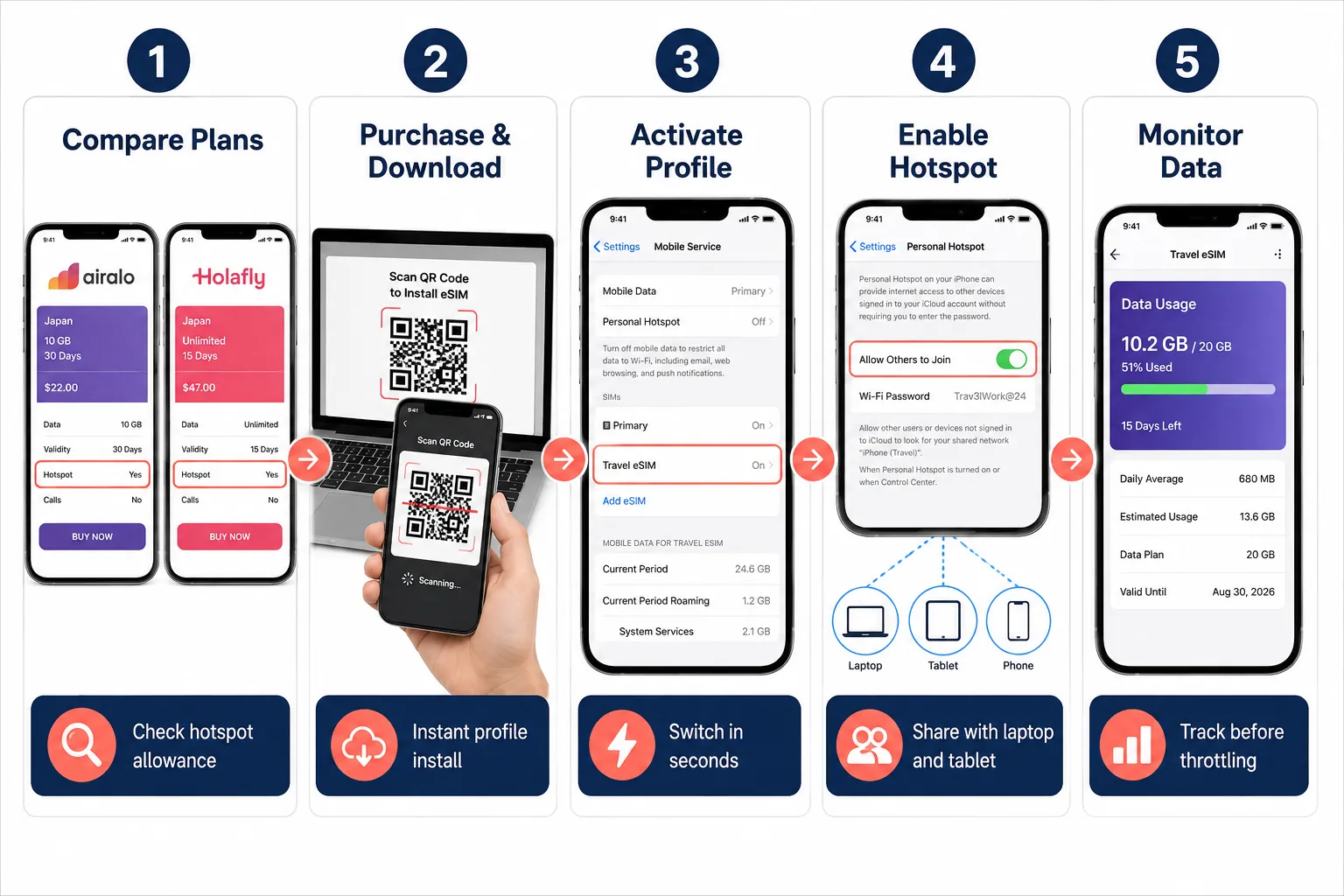
Switching between eSIM providers takes under 5 minutes and requires no physical hardware change. This is one of the most practical advantages of eSIM for remote workers who want to compare providers or switch when crossing a border.
Step-by-step process:
- Purchase a new plan from the target provider (Airalo, Holafly, Nomad, Ubigi, or Saily).
- Receive the QR code or activation code by email or in-app.
- On your phone, go to Settings > Cellular (iOS) or Settings > Connections > SIM Manager (Android).
- Select “Add eSIM” and scan the QR code or enter the activation code.
- Once installed, go to your eSIM list and toggle the new profile on.
- Set the new eSIM as your primary data line.
- The old eSIM profile remains stored on your device, you can switch back at any time without repurchasing (as long as the plan has remaining data or validity).
Common mistake: Deleting an eSIM profile before the data is used up. Most providers do not allow reinstallation of a deleted profile. Always deactivate rather than delete if you plan to return to a provider.
Device storage limit: Most phones store 5-20 eSIM profiles simultaneously, though only one (or two on dual-SIM devices) can be active at a time.
Which eSIM Provider Has the Best Customer Support
Holafly and Saily lead on customer support quality among the top 5 eSIM providers with unlimited hotspot sharing for remote workers. Both offer 24/7 live chat with response times typically under 5 minutes based on user-reported experiences across travel forums and app store reviews as of 2026.
Support comparison:
- Holafly: 24/7 live chat, email support, active social media response. Known for fast resolution of activation issues.
- Saily: 24/7 live chat backed by NordVPN’s established support infrastructure. Strong onboarding documentation.
- Airalo: In-app chat and email; response times can be slower during peak periods. Large FAQ library covers most common issues.
- Nomad: Email and in-app chat; generally responsive but less consistently fast than Holafly or Saily.
- Ubigi: Email support with a more technical focus; better suited to users comfortable with self-service troubleshooting.
When support matters most: Activation failures at airports or border crossings are the most common support scenarios. Holafly’s 24/7 live chat is the most reliable option in these time-sensitive situations.
eSIM Hotspot Reliability for Full-Time Remote Work
eSIM hotspots are reliable enough for full-time remote work in most urban and suburban environments in developed markets. The main reliability risks are network congestion in dense urban areas, coverage gaps in rural or mountainous regions, and daily throttling limits.
Reliability factors to assess before relying on eSIM as your primary connection:
- Location: Urban centers in Europe, North America, Japan, South Korea, and Australia offer the most consistent 4G/5G coverage.
- Provider: Ubigi and Holafly have the strongest infrastructure partnerships for consistent speeds.
- Backup plan: Always have a secondary option, a local SIM, a hotel or coworking space WiFi, or a second eSIM profile from a different provider.
- Work type: Developers, writers, and project managers who work primarily through cloud tools (Google Workspace, Notion, Slack) can work comfortably on eSIM hotspot. Video editors uploading large files or engineers running continuous data pipelines will find the bandwidth limiting.
Recommended setup for full-time remote workers:
- Primary: Holafly or Ubigi unlimited eSIM plan for daily work.
- Backup: Airalo local plan for the destination country, kept as a secondary profile.
- Coworking space or cafe WiFi for high-bandwidth tasks (large uploads, software downloads).
Frequently Asked Questions
What is the difference between an eSIM and a regular SIM card?
An eSIM is a digital SIM embedded in your device that activates via QR code, with no physical card required. A regular SIM is a removable physical chip. Both connect you to carrier networks, but eSIMs allow instant switching between providers and support multiple stored profiles on one device.
Do all eSIM plans allow hotspot sharing?
No. Some eSIM plans, particularly lower-cost capped plans on Airalo and similar marketplaces, restrict hotspot tethering based on the underlying carrier’s policy. Always check the plan’s terms under “hotspot” or “tethering” before purchasing. Holafly, Saily, and Nomad confirm hotspot support on all their plans.
Will an eSIM work on my phone?
Most flagship smartphones released after 2019 support eSIM, including iPhone XS and later, Samsung Galaxy S20 and later, Google Pixel 3 and later, and many recent mid-range Android devices. Your phone must also be carrier-unlocked. Check your device specifications under “SIM” or visit your manufacturer’s support page to confirm.
What happens to my eSIM data if I travel to a country not covered by my plan?
Your eSIM plan will not provide data outside its covered region. Your phone will either show no service or fall back to your physical SIM if one is installed. You can add a new eSIM plan for the new destination without deleting your existing profile.
Is eSIM hotspot safe to use for work?
eSIM hotspot connections are as secure as any mobile data connection. For work involving sensitive data, use a VPN (such as NordVPN, which is also integrated with Saily) to encrypt your traffic, especially when connecting multiple devices through the hotspot.
Can I use an eSIM and a physical SIM at the same time?
Yes, on dual-SIM devices. Most modern flagship phones support one physical SIM and one eSIM simultaneously, or two eSIMs. This lets you keep your home number active on the physical SIM while using an eSIM for local data.
How long does it take to activate an eSIM?
Activation typically takes 2-10 minutes from purchase to working data connection. Most providers deliver the QR code instantly by email. Scanning and installing the profile takes under 2 minutes on most devices.
Are there countries where eSIMs do not work?
A small number of countries restrict or have limited eSIM infrastructure, including some in Central Asia, parts of Sub-Saharan Africa, and a few Caribbean nations. Always check your provider’s coverage map before traveling to less common destinations.
Conclusion
The top 5 eSIM providers with unlimited hotspot sharing for remote workers, Airalo, Holafly, Nomad, Ubigi, and Saily, each serve a distinct set of needs. Holafly and Saily are the strongest choices for straightforward unlimited plans with confirmed hotspot support. Ubigi leads on speed in 5G markets. Airalo offers the broadest country coverage. Nomad is the best value for Asia-Pacific routes.
Actionable next steps:
- Confirm your device supports eSIM and is carrier-unlocked before purchasing any plan.
- Match your provider to your primary work region using the comparison table above.
- Start with a 7-day plan from Holafly or Saily to test unlimited hotspot performance before committing to a monthly plan.
- Set up a secondary eSIM profile from Airalo as a backup before departing.
- Schedule bandwidth-heavy tasks (large uploads, software updates) for the start of your day before daily throttling thresholds are reached.
- Use a VPN on all devices connected through your hotspot for work security.
Remote work connectivity no longer requires hunting for local SIM cards or depending on unreliable hotel WiFi. With the right eSIM plan and a basic understanding of how throttling works, a reliable mobile office is available in most countries worldwide.