



Disclaimer: This post contains affiliate links. We may earn a commission if you make a purchase through our links, at no extra cost to you.
Last updated: August 14, 2026

Quick Answer
Yes, it is genuinely possible to travel Europe on $50 a day without sacrificing comfort, but only in the right countries and with the right booking habits. Eastern and Southern Europe offer the best value, where a clean private room, three meals, and local transport can fit inside that budget. Western and Northern Europe require either a higher daily limit or very specific trade-offs.
Key Takeaways
- A $50-per-day Europe budget is realistic in countries like Albania, Portugal, Poland, Hungary, and the Balkans, but not in Switzerland, Norway, or Iceland.
- That $50 covers accommodation ($15,$25), food ($10,$18), local transport ($5,$10), and a small buffer for entry fees or activities.
- Budget airlines like Ryanair, Wizz Air, and easyJet can reduce intercity travel costs to under $30 if booked 4-8 weeks in advance.
- Hostels with private rooms, guesthouses, and short-stay apartments often beat Airbnb on price in Eastern Europe.
- Street food, local markets, and lunch menus (set-price midday meals) are the most reliable way to eat well for under $15 a day.
- Travel insurance, SIM cards, and visa fees are hidden costs that can add $5,$10 per day if not planned for.
- Traveling in shoulder season (April, May or September, October) cuts accommodation costs by 20-40% compared to peak summer.
- The biggest budget mistakes are booking last-minute flights, staying in tourist-center hotels, and eating at restaurants with English menus near major landmarks.
Is $50 a Day in Europe Actually Realistic or Just Clickbait?
A $50-per-day Europe budget is real, but it comes with geographic conditions. In Eastern Europe and parts of Southern Europe, $50 a day is enough for a clean private room, three meals, and local transport. In Paris, Amsterdam, or Zurich, $50 covers roughly one meal and a metro ticket.
The key is choosing the right destinations. Budget travel writers who claim $50 a day works everywhere in Europe are either staying in 12-bed dorms and eating instant noodles, or they are traveling exclusively in lower-cost regions. This guide focuses on the latter approach: choosing countries where $50 buys genuine comfort, not just survival.
For a real-world comparison, Albania is one of the most affordable countries in Europe. A detailed look at costs there can be found in this Albania 7-day road trip cost and budget guide, which shows daily totals well under $50 even with a rental car.
What Does a $50-a-Day Europe Budget Actually Include?
A $50-per-day budget for Europe typically covers four categories: accommodation, food, local transport, and a small daily buffer. Here is how those costs break down in a realistic mid-range scenario for Eastern or Southern Europe.
| Category | Low End | Mid Range | Notes |
|---|---|---|---|
| Accommodation | $12 | $22 | Hostel private room or guesthouse |
| Food | $10 | $18 | Street food, markets, one sit-down meal |
| Local Transport | $3 | $8 | Buses, trams, occasional taxi |
| Activities / Entry Fees | $0 | $5 | Many museums have free days |
| Daily Buffer | $3 | $5 | Coffee, SIM data, small purchases |
| Total | $28 | $58 | Average across Eastern/Southern Europe |
Note that intercity flights and long-distance trains are not included in this daily figure. Those are one-time costs that should be budgeted separately per trip leg.
Which Are the Cheapest Countries to Visit in Europe on a Budget?
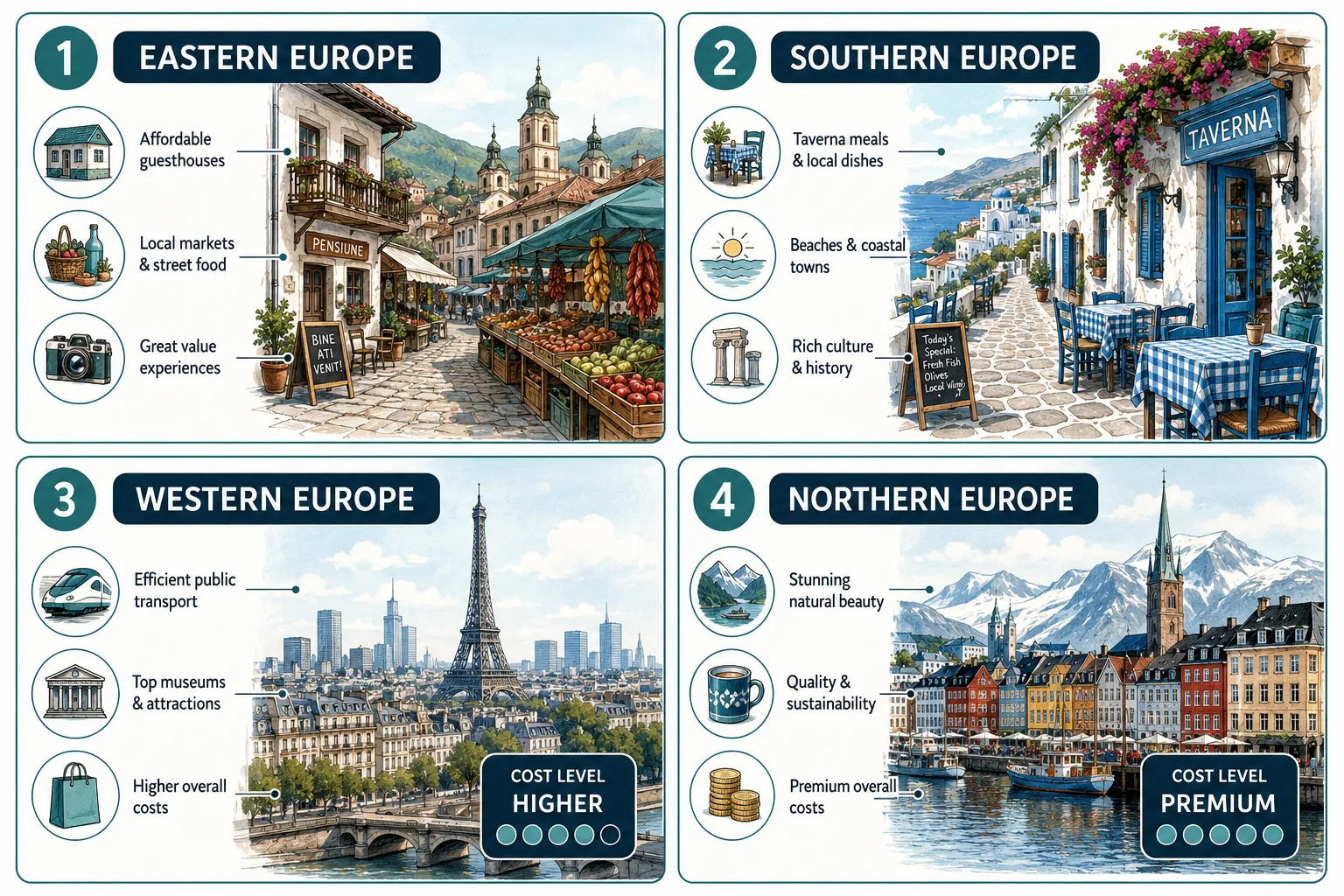
The cheapest countries for budget travel in Europe in 2026 are concentrated in Eastern Europe and the Western Balkans. These destinations offer the most value for travelers aiming to travel Europe on $50 a day without sacrificing comfort.
Best value destinations:
- Albania, One of the most affordable countries on the continent. Guesthouses in coastal towns like Saranda run $15,$25 per night. Local food is excellent and inexpensive.
- North Macedonia and Kosovo, Capital cities Skopje and Pristina offer clean accommodation for $18,$30 and full meals for $5,$8.
- Poland, Krakow and Gdansk are among the best-value cities in Central Europe. A private hostel room costs $18,$28, and the food scene is strong.
- Hungary, Budapest remains one of the most affordable capital cities in the EU, with thermal baths, ruin bars, and excellent cuisine all accessible on a tight budget.
- Portugal, Porto and the Alentejo region are significantly cheaper than Lisbon. A guesthouse room in Porto averages $25,$35.
- Romania and Bulgaria, Both countries offer very low food and accommodation costs, with strong infrastructure for independent travelers.
Countries where $50 a day is very difficult:
Switzerland, Norway, Denmark, Iceland, and the Netherlands all have average daily costs well above $100 for even modest travel. Western Europe (France, Germany, Austria) sits in the middle, possible on $50 a day with strict trade-offs, but not comfortable.
Is $50 a Day Enough for Southern Europe vs. Eastern Europe?
Eastern Europe is the clearer winner for a $50-per-day budget. Southern Europe is possible in some countries but requires more planning.
Eastern Europe: Countries like Poland, Hungary, Romania, Bulgaria, and the Western Balkans consistently allow comfortable travel under $50 per day. Accommodation, food, and transport are all priced well below Western European norms.
Southern Europe: Portugal, Greece (outside peak season), and parts of Spain (smaller cities, inland towns) can work within a $50 budget. Italy is harder, Rome and Florence push accommodation costs up significantly, though Sicily and Calabria remain affordable. Croatia’s coast has become expensive in summer but is manageable in April or October.
The honest rule: If the destination is a major Western European capital in July or August, $50 a day will not cover comfort. If it is a mid-size city in Eastern or Southern Europe in shoulder season, $50 is not just enough, it may leave money to spare.
How to Find Affordable Accommodation in Europe: Hostels vs. Airbnb vs. Guesthouses
For budget travelers in Europe, the best accommodation value in 2026 is usually a hostel private room or a local guesthouse, not Airbnb. Airbnb service fees and cleaning charges have pushed prices up significantly in most European cities, often making it more expensive than a comparable guesthouse.
Accommodation options compared:
- Hostel private rooms, Best value in Eastern Europe. Platforms like Hostelworld and Booking.com list private rooms in well-reviewed hostels for $15,$28 per night. Shared facilities keep costs low without forcing dorm sleeping.
- Local guesthouses and pensions, Common in the Balkans, Portugal, and Greece. Often family-run, frequently include breakfast, and average $20,$35 per night.
- Airbnb, Still useful for stays of 5+ nights where weekly discounts apply. For short stays, fees make it uncompetitive with guesthouses.
- Booking.com apartments, Often cheaper than Airbnb for similar properties, with no surprise cleaning fees at checkout.
Practical tips:
- Book accommodation in advance for peak months (June, August), but stay flexible in shoulder season when last-minute deals appear.
- Filter by “free cancellation” to allow itinerary changes without penalties.
- Read reviews specifically for cleanliness and noise, comfort matters even on a budget.
Best Budget Airlines in Europe and How to Book Cheap Flights
The three dominant budget airlines in Europe are Ryanair, Wizz Air, and easyJet. Together they cover most intra-European routes and can bring flight costs down to $15,$40 one-way when booked correctly.
How to book cheap European flights:
- Set fare alerts on Google Flights or Skyscanner for your target routes. Prices fluctuate daily.
- Book 4-8 weeks in advance for the best balance of availability and price. Last-minute budget airline fares are rarely cheap.
- Travel on Tuesday, Wednesday, or Saturday, these days consistently show lower fares than Monday or Friday.
- Use nearby airports. Ryanair and Wizz Air often fly into secondary airports (e.g., Beauvais instead of Paris CDG, Bergamo instead of Milan Malpensa). Factor in the transfer cost.
- Pack light enough to avoid checked baggage fees. A 10kg carry-on is free on most budget carriers; checked bags can add $25,$50 per flight.
- Consider overnight buses or trains as alternatives. FlixBus and Omio cover most of Europe at $15,$40 per leg, and overnight travel saves a night of accommodation.
For travelers planning a longer Asia-Europe trip, the same principles of booking in advance and using budget carriers apply, as explored in this guide to cheapest ways to travel around Kyushu, Japan.
How Much Does Food Cost in Europe, and Can You Eat Well on a Budget?
Food costs in Europe vary widely by country, but eating well on a budget is consistently achievable through three approaches: street food, local markets, and the set-price lunch menu.
Average meal costs by region (2026 estimates):
- Eastern Europe (Poland, Hungary, Romania): Full sit-down meal at a local restaurant, $5,$9. Street food, $2,$4.
- Balkans (Albania, North Macedonia, Serbia): Full meal with a drink, $4,$7. Local bakeries offer excellent pastries for $0.50,$1.
- Southern Europe (Portugal, Greece, southern Spain): Set lunch menu (menú del día / menu do dia), $8,$13 including a drink. Street food, $3,$6.
- Western Europe (France, Germany, Netherlands): Budget restaurant meal, $14,$22. Supermarket lunch, $6,$10.
The set-price lunch menu is the single best food value in Southern and Western Europe. Most restaurants in Spain, Portugal, France, and Italy offer a two- or three-course lunch with a drink for a fixed price that is 30-50% cheaper than ordering à la carte at dinner.
Supermarket strategy: Buying breakfast and one meal per day from a supermarket (Lidl and Aldi operate across Europe) cuts food costs by $5,$8 per day without sacrificing quality.
What Is the Difference Between Backpacking Europe and Budget Travel With Comfort?
Backpacking Europe traditionally means dorm beds, minimal itinerary, and maximum flexibility. Budget travel with comfort means private rooms, planned routes, and selective spending, still affordable, but not austere.
The distinction matters because the two approaches have different cost profiles:
- Traditional backpacking: $25,$40 per day. Dorm beds ($8,$15), street food only, free activities. Prioritizes cost above all else.
- Budget travel with comfort: $40,$65 per day. Private hostel rooms or guesthouses ($18,$28), one sit-down meal daily, occasional paid attraction. Prioritizes value and a reasonable standard of living.
Learning how to travel Europe on $50 a day without sacrificing comfort sits firmly in the second category. The goal is not to spend as little as possible, it is to spend wisely enough that the trip is enjoyable and sustainable for weeks at a time.
“The difference between a $30-a-day trip and a $50-a-day trip in Eastern Europe is often the difference between a dorm bed and a private room. That extra $15 per night is worth it for most travelers over the age of 25.”
Travel Insurance and Other Hidden Costs People Forget About
Travel insurance is the most commonly overlooked budget item for European travel, and skipping it is a serious financial risk. A single medical evacuation in Europe can cost tens of thousands of dollars without coverage.
Hidden costs that affect your real daily average:
- Travel insurance: SafetyWing is the most popular option for budget travelers and digital nomads, costing roughly $1.50,$2.50 per day for basic coverage (rates vary by age and region, per SafetyWing’s published pricing). World Nomads covers more activities at a higher price point.
- SIM cards and data: A local SIM in most European countries costs $5,$15 for 30 days of data. eSIM options are increasingly available and convenient. For travelers also visiting the Middle East, a comparison of eSIM cards for Oman travel illustrates how eSIM pricing works across regions.
- Visa fees: Most EU/Schengen countries are visa-free for US, UK, Canadian, and Australian passport holders. However, the EU’s ETIAS authorization (expected to be operational in 2026) will add a small one-time fee per application.
- ATM and currency fees: Using a Wise or Revolut card eliminates most foreign transaction fees. Standard bank debit cards can charge 2-3% per transaction plus ATM withdrawal fees.
- Luggage storage: Train station lockers in major cities cost $5,$10 for a few hours. Budget for this on travel days.
- City tourist taxes: Many European cities (Venice, Barcelona, Amsterdam, Paris) charge a nightly tourist tax of $1,$7 per person. It is added at checkout and is often not included in booking platform prices.
When these costs are averaged across a trip, they typically add $5,$10 to the real daily total. A realistic budget for comfortable European travel is therefore $50,$60 per day in Eastern/Southern Europe, not a hard $50 ceiling.
Best Time of Year to Travel Europe Cheaply
Shoulder season, April through May and September through October, offers the best combination of lower prices, manageable crowds, and good weather across most of Europe.
Seasonal cost breakdown:
- Peak season (June, August): Accommodation prices rise 30-60% in popular destinations. Flights are more expensive. Crowds at major sites are at their worst.
- Shoulder season (April, May, September, October): Best value. Weather is good in Southern and Eastern Europe. Prices drop significantly. Many budget travelers find this is when $50 a day works most comfortably.
- Low season (November, March): Cheapest prices, but cold weather limits outdoor activities in Northern and Central Europe. Southern Europe (Portugal, southern Spain, Greece) remains pleasant and very affordable.
Practical tip: Avoid major European holidays (Easter week, Christmas markets in December) even in shoulder season, these periods spike prices in specific cities regardless of the calendar month.
Common Mistakes Budget Travelers Make in Europe
Most budget travel failures in Europe come down to a handful of avoidable errors. Knowing these in advance is the fastest way to protect a $50-per-day budget.
The most costly mistakes:
- Booking flights last-minute. Budget airline fares spike in the final two weeks before departure. A flight that costs $25 booked six weeks out can cost $120 booked two days out.
- Staying in the tourist center. Accommodation within 500 meters of a major landmark (Eiffel Tower, Colosseum, Charles Bridge) costs 40-80% more than equivalent rooms 15-20 minutes away by metro.
- Eating at restaurants with picture menus near tourist sites. These restaurants charge 2-3x local prices. Walking two streets away from any major attraction cuts meal costs immediately.
- Ignoring free museum days. Most major European museums have at least one free entry day per week or month. The Louvre is free for under-26s from EU countries. The British Museum is always free. Research before paying entry fees.
- Not tracking spending daily. Without a simple daily log, overspending on one day compounds across a trip. Apps like Trail Wallet or a basic spreadsheet take two minutes per day.
- Underestimating transport costs between cities. Booking intercity travel as part of the daily budget rather than as a separate line item distorts the real picture.
For more practical budget travel content and destination-specific guides, the RoamBudget blog covers a range of affordable travel destinations and cost breakdowns.
How to Travel Europe Comfortably Without Spending a Lot: A Practical Framework
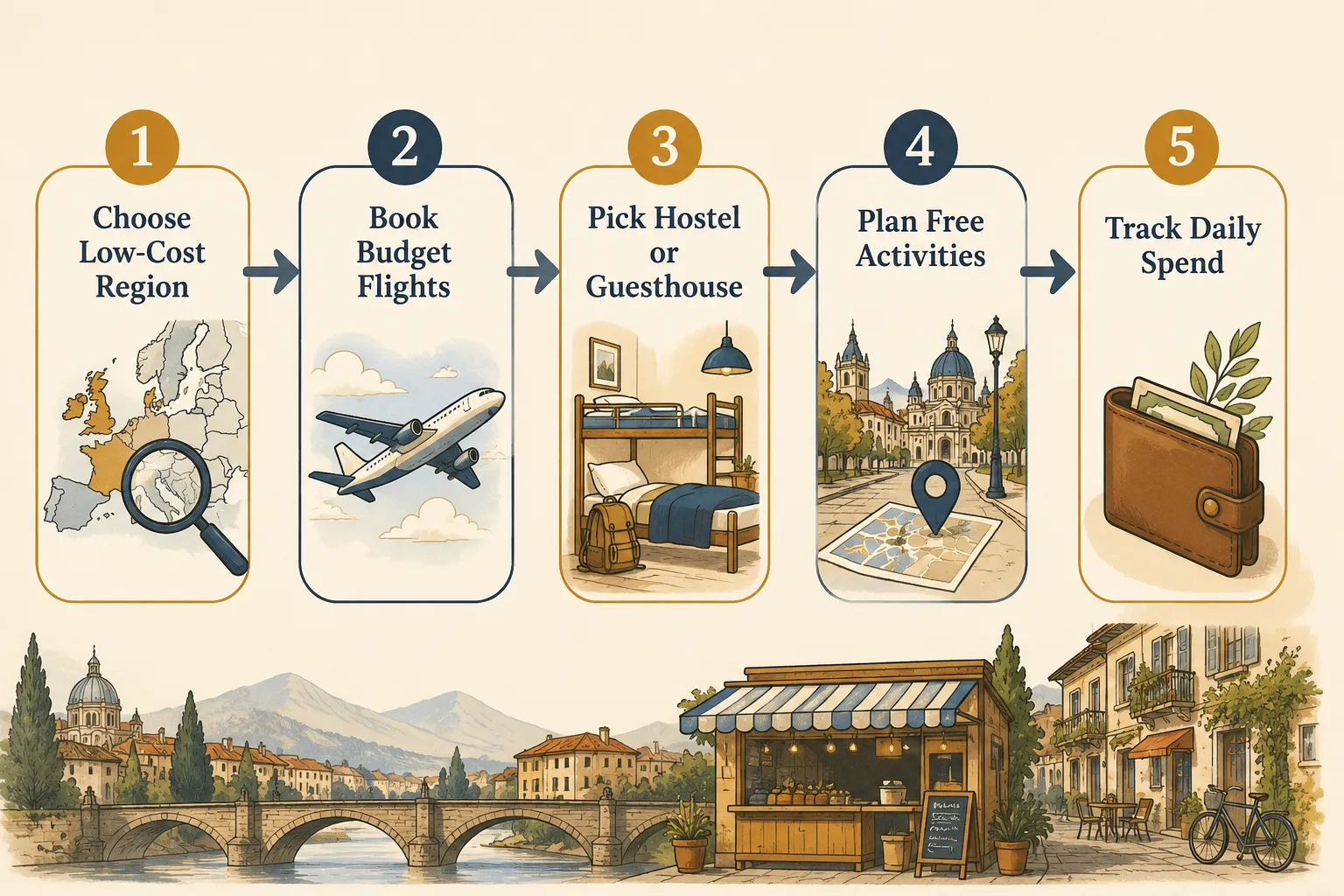
Traveling Europe comfortably on a limited budget requires a system, not just willpower. The travelers who consistently manage how to travel Europe on $50 a day without sacrificing comfort follow a repeatable approach.
The framework:
- Choose your region first. Decide whether Eastern Europe, the Balkans, or Southern Europe fits your interests. This single decision determines whether $50 a day is easy, possible, or impossible.
- Book accommodation before flights. Confirm that affordable private rooms exist in your target cities before committing to flight dates.
- Set a daily spending limit by category. Allocate specific amounts for food, transport, and activities rather than tracking a single total. This prevents one category from silently consuming the budget.
- Use a fee-free bank card. Wise and Revolut both offer real exchange rates with low or no transaction fees. This alone saves $3,$7 per day compared to standard bank cards.
- Plan one free activity per day. Europe has an extraordinary density of free attractions: public beaches, historic old towns, city parks, free museum days, and free walking tours (tip-based). These are often the most memorable experiences.
- Cook or buy from supermarkets for at least one meal per day. This is the single most effective way to stay under budget without feeling restricted.
- Review spending every three days. Catching a drift early prevents a budget blowout by day ten.
Conclusion
Traveling Europe on $50 a day without sacrificing comfort is achievable in 2026, but it requires honest destination selection, advance planning, and a few disciplined habits. Eastern Europe and the Western Balkans are the strongest choices for this budget. Southern Europe works in shoulder season and in smaller cities. Western and Northern Europe require a higher daily limit or very specific trade-offs.
Actionable next steps:
- Choose a target region from the cheapest countries listed above and research specific city costs before booking.
- Set up a Wise or Revolut account before departure to eliminate currency conversion fees.
- Book accommodation and intercity transport at least 3-4 weeks in advance to access the best prices.
- Purchase travel insurance before your first flight, SafetyWing and World Nomads are the two most used options among independent travelers.
- Build a simple daily budget spreadsheet with four categories: accommodation, food, transport, and buffer.
The travelers who struggle with a $50-a-day Europe budget are usually those who apply it to the wrong destinations or skip the planning steps. The travelers who succeed find that Eastern Europe in particular offers genuine comfort, excellent food, and rich culture at a fraction of what Western Europe costs. Start there.
Frequently Asked Questions
Can you actually travel Europe on $50 a day in 2026?
Yes, in Eastern Europe and parts of Southern Europe, $50 per day is enough for a private room, three meals, and local transport. It does not work in Western or Northern Europe without significant compromises.
What is the cheapest country to travel in Europe?
Albania, Kosovo, and North Macedonia are consistently among the cheapest countries in Europe for independent travelers. Poland, Hungary, Romania, and Bulgaria are also strong value options with better infrastructure for first-time visitors.
Is a hostel private room or Airbnb better for budget travel in Europe?
In most Eastern European cities, a hostel private room is cheaper than a comparable Airbnb once service fees and cleaning charges are factored in. Airbnb is more competitive for stays of five or more nights where weekly discounts apply.
What budget airline should I use for travel within Europe?
Ryanair, Wizz Air, and easyJet cover the widest range of European routes at the lowest base prices. Book 4-8 weeks in advance and travel with carry-on only to avoid baggage fees.
Does the $50-per-day budget include flights between countries?
No. Intercity and international flights should be budgeted separately as one-time trip costs. The $50-per-day figure covers in-destination spending: accommodation, food, local transport, and activities.
Is travel insurance worth it for a budget Europe trip?
Yes. Medical care in Europe can be expensive for non-EU travelers without coverage. SafetyWing offers basic coverage at roughly $1.50,$2.50 per day, which fits within a $50 daily budget and provides meaningful financial protection.
What is the best time of year to travel Europe on a budget?
April, May and September, October offer the best combination of lower prices, smaller crowds, and good weather. Avoid June through August in popular coastal and city destinations, where accommodation prices rise 30-60%.
How do I avoid ATM fees while traveling Europe on a budget?
Use a Wise or Revolut card. Both offer real mid-market exchange rates with minimal fees, saving $3,$7 per day compared to standard bank debit or credit cards with foreign transaction fees.
Sources
- Numbeo Cost of Living Database, https://www.numbeo.com (2024-2025 city-level data)
- SafetyWing Nomad Insurance pricing, https://www.safetywing.com (2025)
- Hostelworld accommodation data, https://www.hostelworld.com (2025)
- Skyscanner flight price research, https://www.skyscanner.com (2025)
- Wise fee structure, https://wise.com (2025)