Disclaimer: This post contains affiliate links. We may earn a commission if you make a purchase through our links, at no extra cost to you.
Last updated: August 14, 2026
Quick Answer
A 7-day road trip in the United States costs between $700 and $2,500 for one or two travelers, depending on fuel prices, lodging choices, and destination. The biggest cost drivers are gas, accommodation, and food. This Total Cost Breakdown of a 7-Day Road Trip: A 2026 Budgeting Guide covers every expense category so you can plan with real numbers.
Key Takeaways
- The average total cost for a 7-day road trip in 2026 ranges from $700 to $2,500 for two people, with solo travelers spending roughly $500 to $1,500.
- Fuel is typically the single largest expense, often accounting for 25 to 40 percent of the total budget.
- Accommodation costs vary widely: camping runs $15 to $45 per night, while mid-range motels average $80 to $130 per night.
- Food costs average $30 to $60 per person per day, depending on how often you cook versus eat out.
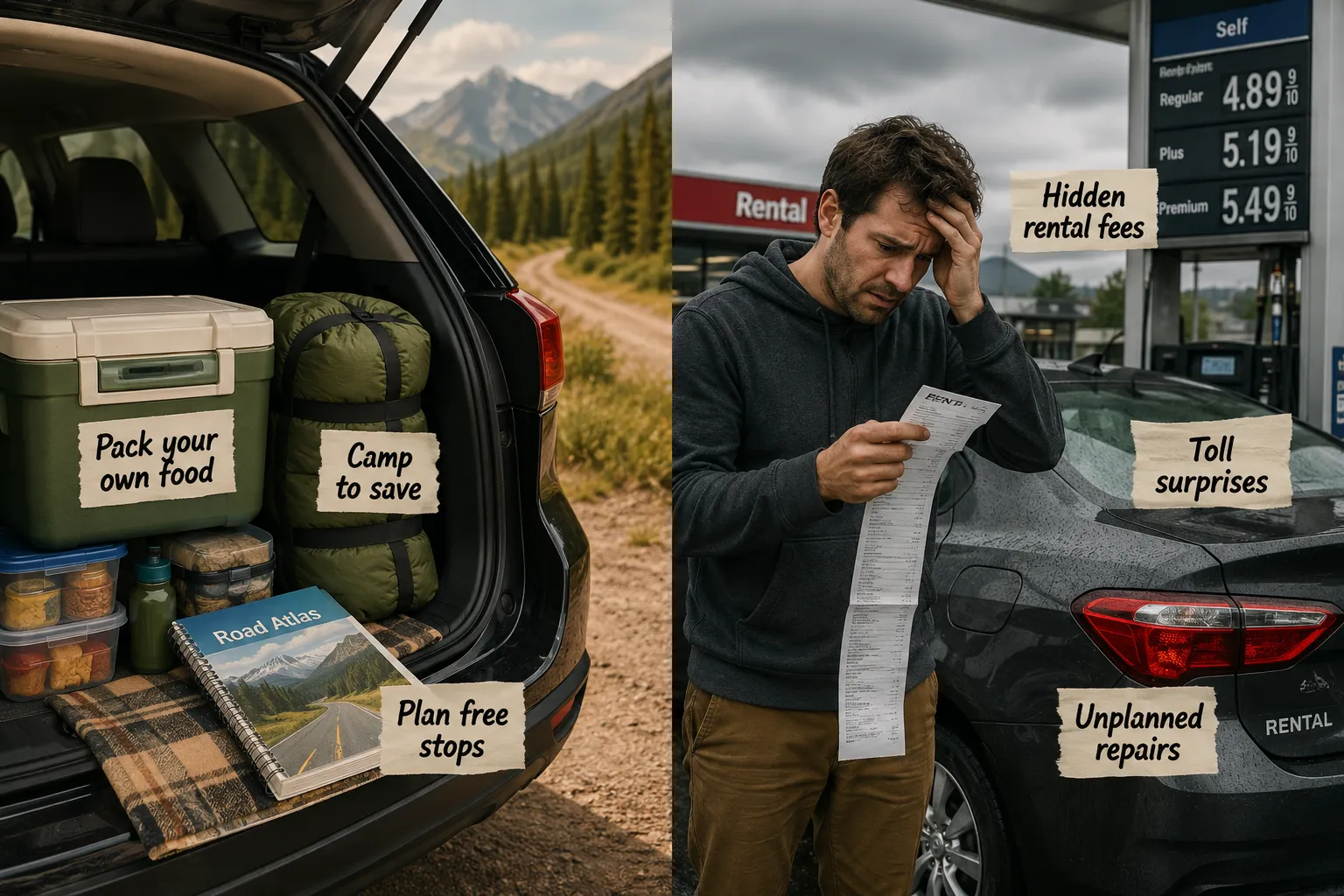
- Hidden costs such as tolls, parking, national park fees, and emergency car maintenance can add $150 to $400 to any trip.
- A 7-day road trip under $1,000 is achievable for one or two people who camp, cook their own meals, and choose free destinations.
- Road tripping is generally cheaper than flying for groups of two or more traveling under 1,000 miles.
- Using a road trip budget calculator before you depart is the most effective way to avoid overspending.
What Is the Average Cost of a 7-Day Road Trip in 2026
The average cost of a 7-day road trip in 2026 is approximately $1,200 to $1,600 for two people covering 1,500 to 2,000 miles. Solo travelers can expect to spend $600 to $1,100 for the same distance and duration. Costs shift significantly based on vehicle fuel efficiency, accommodation style, and the region traveled.
Here is a realistic cost summary table for a two-person, 7-day road trip in 2026:
| Expense Category | Budget Option | Mid-Range | Comfortable |
|---|---|---|---|
| Fuel (1,500 miles) | $150 | $220 | $280 |
| Accommodation (7 nights) | $105 (camping) | $630 (motels) | $1,050 (hotels) |
| Food (2 people, 7 days) | $280 | $490 | $840 |
| Activities & Attractions | $50 | $150 | $300 |
| Tolls & Parking | $20 | $60 | $100 |
| Car Maintenance Buffer | $50 | $75 | $100 |
| Estimated Total | $655 | $1,625 | $2,670 |
Fuel estimates assume a vehicle averaging 28 MPG and gas at approximately $3.40 to $3.80 per gallon (U.S. Energy Information Administration average projections for 2026). Actual prices vary by state and season.
For a country-specific breakdown, see the Albania 7-Day Road Trip Cost: Full Budget Guide 2026 for a useful comparison of how road trip costs differ internationally.
What Is Included in a Total Road Trip Cost Breakdown
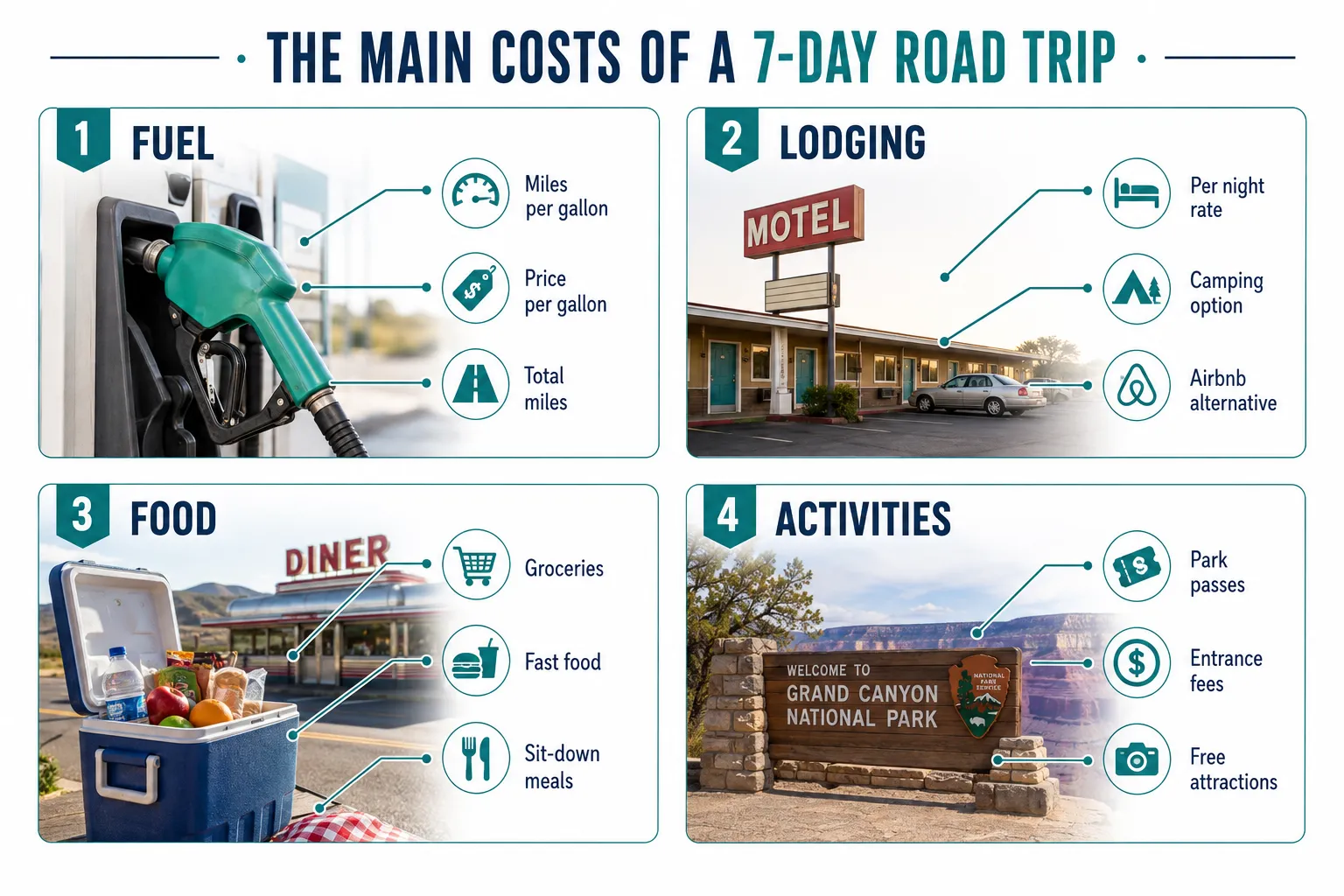
A complete road trip cost breakdown covers six core categories. Understanding all six prevents the budget gaps that catch most travelers off guard.
The six cost categories are:
- Fuel – calculated from total miles, vehicle MPG, and local gas prices
- Accommodation – campgrounds, motels, hotels, or Airbnb stays
- Food and drinks – groceries, restaurants, coffee stops, and snacks
- Activities and attractions – national park passes, tours, entry fees
- Tolls and parking – highway tolls, city parking, bridge fees
- Vehicle costs – pre-trip maintenance, oil changes, tire checks, and an emergency buffer
Each category interacts with the others. For example, choosing a campsite over a motel frees up budget for paid attractions. Cooking most meals offsets the cost of a nicer hotel night.
How Much Should You Budget for Gas on a Week-Long Road Trip
Fuel costs for a 7-day road trip depend on three variables: total miles driven, your vehicle’s fuel efficiency (MPG), and the current price of gas in the states you pass through.
Formula:
(Total Miles / MPG) x Price Per Gallon = Estimated Fuel Cost
Practical examples for 2026:
- 1,000 miles in a 30 MPG sedan at $3.60/gallon: $120
- 1,500 miles in a 25 MPG SUV at $3.70/gallon: $222
- 2,000 miles in a 20 MPG truck at $3.80/gallon: $380
- 1,500 miles in a 40 MPG hybrid at $3.60/gallon: $135
Tips to reduce fuel costs:
- Use GasBuddy or the AAA gas price tracker to find the cheapest stations along your route.
- Fill up in rural areas or states with lower fuel taxes (states like Missouri and Texas typically run lower than California or Hawaii).
- Maintain steady highway speeds between 55 and 65 mph to maximize fuel efficiency.
- Avoid idling in traffic by planning departures outside peak hours.
Cheapest Places to Stay During a Road Trip
The cheapest accommodation options for road trippers in 2026 are dispersed camping on Bureau of Land Management (BLM) land and U.S. Forest Service land, which is free in most areas. Paid campgrounds at state parks average $15 to $35 per night, while private campgrounds (KOA, Hipcamp) run $25 to $55 per night.
Accommodation options ranked by average nightly cost (2026 estimates):
| Option | Average Nightly Cost | Best For |
|---|---|---|
| BLM / dispersed camping | Free to $5 | Tent or van travelers |
| State park campground | $15 – $35 | Tent and RV travelers |
| Private campground (KOA) | $25 – $55 | Families, RV hookups |
| Budget motel (Motel 6, Super 8) | $55 – $90 | Solo or couple travelers |
| Mid-range hotel | $90 – $150 | Comfort-focused travelers |
| Airbnb (private room) | $60 – $120 | Groups or longer stays |
| Airbnb (full home) | $100 – $200 | Families or groups of 4+ |
Choose camping if you have a tent or sleeping setup in the car and are traveling through the American West, where free BLM land is abundant. Choose budget motels if you need reliable Wi-Fi for remote work or are traveling through the Midwest or Southeast where free camping is harder to find.
For more ideas on budget travel strategies across different destinations, the RoamBudget blog covers a range of practical guides.
Food Costs for a 7-Day Road Trip: How Much to Spend
Food costs for a 7-day road trip average $30 to $60 per person per day, which translates to $210 to $420 per person for the full week. The range is wide because cooking your own meals can cut daily food costs to $15 to $25 per person, while eating at sit-down restaurants for every meal pushes costs to $60 to $90 per person per day.
Daily food cost breakdown by approach:
- Cook everything yourself (cooler + camp stove): $15 to $25/person/day
- Mix of cooking and fast food: $25 to $40/person/day
- Mostly fast food and casual dining: $40 to $60/person/day
- Sit-down restaurants for most meals: $60 to $90/person/day
Practical strategies to keep food costs low:
- Pack a quality cooler with pre-made meals, sandwich ingredients, fruit, and snacks before departure.
- Buy groceries at Walmart, Aldi, or Trader Joe’s rather than convenience stores, which charge 30 to 50 percent more for the same items.
- Limit coffee shop stops. A travel thermos and a bag of ground coffee saves $5 to $8 per day.
- Use the free breakfast at budget hotels when available. Many chains include it in the room rate.
Tolls and Parking Fees for Road Trips: What to Expect
Tolls and parking fees are easy to underestimate but can add $50 to $200 to a 7-day road trip depending on the route. Heavily tolled corridors like the I-95 Northeast, the Illinois Tollway, and the Florida Turnpike can cost $20 to $40 per day on their own.
Toll and parking cost estimates by route type:
- Rural/Western routes (I-90 Montana, US-50 Nevada): $0 to $20 total
- Midwest routes (Illinois, Indiana, Ohio): $20 to $60 total
- Northeast corridor (I-95 Boston to Washington): $60 to $120 total
- Florida routes: $30 to $80 total
How to reduce toll costs:
- Use Google Maps or Waze and select “avoid tolls” to find free alternate routes.
- Get an E-ZPass (or regional equivalent) if traveling through the Northeast. It typically saves 20 to 40 percent versus cash toll rates.
- For city parking, use the SpotHero or ParkWhiz apps to book cheaper lots in advance.
Hidden Costs People Forget About on Road Trips
Hidden costs are the most common reason road trip budgets go over. Most travelers account for gas, food, and lodging but miss several smaller categories that add up fast.
The most frequently overlooked road trip expenses:
- National park and state park entrance fees: America the Beautiful Annual Pass costs $80 and covers unlimited entry to all federal parks for one year. If visiting two or more national parks, it pays for itself immediately.
- Vehicle wear and maintenance: Every 1,000 miles adds measurable wear to tires, brakes, and oil. Budget $50 to $100 as an emergency buffer per trip.
- Roadside assistance or travel insurance: AAA membership starts at around $65 per year. A single tow without it can cost $75 to $200.
- Laundry: A week of clothes means at least one laundromat stop, averaging $10 to $20.
- Cell phone data overages: Streaming music and using GPS in areas without Wi-Fi drains data quickly. Check your plan before departure.
- Souvenirs and impulse purchases: Set a firm limit of $20 to $50 to avoid overspending at roadside stops.
- Pet fees: Many motels charge $15 to $30 per night for pets.
How Much Does Car Maintenance Add to a Road Trip
Pre-trip and during-trip car maintenance adds $50 to $300 to the total cost of a 7-day road trip, depending on the vehicle’s condition before departure. Skipping a pre-trip inspection is one of the most expensive mistakes road trippers make.
Recommended pre-trip maintenance checks and estimated costs:
- Oil change: $40 to $80 (skip if done within the last 3,000 miles)
- Tire pressure check and rotation: $0 to $60
- Windshield wiper replacement: $15 to $30
- Air filter check: $15 to $30
- Coolant and brake fluid top-off: $10 to $20
A breakdown on the road is far more expensive than preventive maintenance. The average roadside tow costs $109 to $196 according to AAA (2023 data). Factor in a $75 to $100 emergency buffer for any unexpected repairs.
Is It Cheaper to Road Trip or Fly
Road tripping is cheaper than flying for groups of two or more traveling under 1,000 miles, especially when accommodation costs are managed through camping or budget motels. For solo travelers covering more than 1,500 miles, budget airline fares often undercut road trip costs once fuel, wear, and accommodation are factored in.
Quick comparison: road trip vs. flying for two people, 1,500-mile trip:
| Cost Factor | Road Trip | Flying |
|---|---|---|
| Transportation | $180 (fuel) | $300 to $600 (two round-trip tickets) |
| Accommodation (7 nights) | $105 to $630 | $630 to $1,050 |
| Food | $420 to $840 | $420 to $840 |
| Car rental at destination | $0 | $200 to $400 |
| Estimated Total | $705 to $1,650 | $1,550 to $2,890 |
The road trip wins on transportation cost, but the gap narrows when flying allows travelers to stay in a single city rather than paying for accommodation every night along a route.
Choose road tripping if: you enjoy the journey itself, are traveling with 2 or more people, or plan to camp along the way.
Choose flying if: you’re solo, covering more than 2,000 miles, and the destination city has good public transit.
Best Budget-Friendly Road Trip Destinations in 2026
The best budget road trip destinations combine low accommodation costs, free or cheap attractions, and reasonable fuel distances from major population centers.
Top budget-friendly road trip routes for 2026:
- Pacific Coast Highway (California): Stunning scenery with free beaches and BLM camping. Main costs are California’s higher gas prices.
- Blue Ridge Parkway (Virginia/North Carolina): No tolls, free scenic drive, affordable Appalachian campgrounds.
- US Route 50 (Nevada/Utah): Called “the loneliest road in America,” it offers free BLM camping and minimal traffic. Fuel up carefully as stations are sparse.
- Texas Hill Country Loop: Short distances, cheap fuel, free state parks, and affordable local food.
- Great River Road (Mississippi River): Low-cost Midwest motels, free riverside parks, and minimal tolls.
For travelers considering international road trips, the Albania 7-Day Road Trip Cost: Full Budget Guide 2026 shows how dramatically costs differ in Eastern Europe, where fuel, food, and accommodation are significantly cheaper than in the U.S.
Road Trip Budget Calculator 2026: How to Build Your Own
A road trip budget calculator for 2026 is simply a structured spreadsheet or app that multiplies your specific inputs across each cost category. The most accurate calculators use your actual vehicle’s MPG, real-time gas prices, and confirmed accommodation rates rather than averages.
Step-by-step process to calculate your road trip budget:
- Map your route using Google Maps. Note total miles and identify toll roads.
- Calculate fuel cost: (Total miles / vehicle MPG) x current gas price per gallon.
- Book or estimate accommodation: Multiply nightly rate by 7. Mix camping and motels if needed.
- Set a daily food budget: Multiply per-person daily food estimate by number of people and 7 days.
- Add activity costs: List specific parks, tours, or attractions and look up entry fees.
- Add toll estimates: Use TollGuru or the state DOT website for your route.
- Add a 10 to 15 percent buffer for unexpected expenses.
Free tools that help:
- TollGuru (tollguru.com): Calculates toll costs for any U.S. route.
- GasBuddy: Shows real-time gas prices along your route.
- Roadtrippers: Maps routes with campgrounds, attractions, and lodging options.
- Trail Wallet or TravelSpend apps: Track actual spending against your budget in real time.
Can You Do a 7-Day Road Trip Under $1,000
Yes, a 7-day road trip under $1,000 is achievable for one or two people, but it requires deliberate choices across every cost category. The key levers are camping instead of motels, cooking most meals, choosing a fuel-efficient vehicle, and selecting a route with free attractions.
Sample budget for a 2-person, 7-day road trip under $1,000:
| Category | Strategy | Estimated Cost |
|---|---|---|
| Fuel (1,200 miles, 32 MPG) | Fuel-efficient car, avoid detours | $135 |
| Accommodation (7 nights) | Mix of BLM camping and one motel | $130 |
| Food (2 people, 7 days) | Mostly groceries and packed meals | $280 |
| Activities | National parks (America the Beautiful Pass) | $80 |
| Tolls and parking | Avoid toll roads via Google Maps | $25 |
| Emergency buffer | Small car maintenance fund | $75 |
| Total | $725 |
This budget works best on Western U.S. routes where free BLM camping is plentiful. It becomes harder in the Northeast or Southeast where campgrounds are fewer and motel prices are higher.
How to Plan a Road Trip on a Tight Budget
Planning a road trip on a tight budget means making high-impact decisions early, before departure, rather than trying to cut costs on the road. The biggest savings come from accommodation and food choices, not from skipping small luxuries.
Actionable steps for tight-budget road trip planning:
- Choose a short, loop route to minimize fuel costs and avoid backtracking.
- Buy the America the Beautiful Annual Pass ($80) if visiting two or more national parks or federal recreation areas.
- Pack a full cooler before leaving. Pre-cook meals like pasta, rice dishes, and sandwiches.
- Book campgrounds in advance for peak-season travel (May through September). Popular sites sell out weeks ahead.
- Travel mid-week when motel rates drop 20 to 30 percent compared to weekends.
- Download offline maps on Google Maps or Maps.me to avoid data overages in rural areas.
- Set a daily spending limit using a tracking app and review it each evening.
- Travel with one other person to split fuel and accommodation costs in half.
For travelers planning international budget adventures, the Cheapest Ways to Travel Around Kyushu Japan in 2026 offers a useful parallel guide on minimizing transport costs in a different context.
Road Trip Budgeting Mistakes to Avoid
The most common road trip budgeting mistake is underestimating accommodation costs. Most people budget for fuel accurately but assume they can find cheap lodging on the fly, which rarely works during peak travel season.
Top budgeting mistakes and how to avoid them:
- Not booking campgrounds in advance: Popular sites at national parks and state parks fill up months ahead. Book on Recreation.gov as soon as your dates are set.
- Ignoring vehicle condition before departure: A breakdown mid-trip costs far more than a pre-trip oil change.
- Using a credit card without a travel rewards strategy: Paying for gas and hotels with a flat-rate cashback card (like the Citi Double Cash) returns 2 percent on every purchase. Over a $1,500 trip, that’s $30 back.
- Budgeting for average gas prices, not regional ones: California gas prices regularly run $1.00 to $1.50 per gallon above the national average. Plan for the highest prices on your route.
- Skipping travel insurance or roadside assistance: One tow or urgent care visit without coverage can cost more than the entire trip budget.
- Eating at convenience stores: Convenience store snacks and drinks cost 40 to 60 percent more than the same items at a grocery store. Stop at a supermarket at the start of each day.
Applying the Total Cost Breakdown of a 7-Day Road Trip: A 2026 Budgeting Guide to Your Trip
The Total Cost Breakdown of a 7-Day Road Trip: A 2026 Budgeting Guide framework works best when applied before booking anything. Build the budget in a spreadsheet using the six cost categories above, confirm your vehicle’s actual MPG, and research gas prices and campground availability for your specific route.
Final pre-departure checklist:
- Route mapped and total miles confirmed
- Fuel cost calculated using actual MPG and regional gas prices
- Accommodation booked or confirmed (campgrounds reserved in advance)
- Cooler packed with groceries for at least the first 3 days
- Toll costs estimated using TollGuru
- America the Beautiful Pass purchased if visiting national parks
- Vehicle inspected (oil, tires, fluids)
- Emergency buffer of 10 to 15 percent added to total budget
- Daily spending tracked via app
Conclusion
A well-planned 7-day road trip in 2026 costs between $700 and $2,500 for two people, and the difference between those numbers comes down almost entirely to accommodation and food choices. Fuel is predictable once you know your route and vehicle. The hidden costs, such as tolls, park fees, and maintenance, are manageable with a 10 to 15 percent buffer built into the plan.
Actionable next steps:
- Map your route today and calculate your fuel cost using the formula above.
- Check campground availability on Recreation.gov for your travel dates.
- Buy the America the Beautiful Pass if your route includes national parks.
- Build a simple six-category budget spreadsheet and track every expense with a travel app.
- Do a basic vehicle check at least one week before departure to avoid costly breakdowns.
Road trips reward preparation. The travelers who stick to their budget are almost always the ones who built it carefully before leaving the driveway.
Frequently Asked Questions
How much does a 7-day road trip cost on average in 2026?
A 7-day road trip costs between $700 and $2,500 for two people in 2026, depending on accommodation style, fuel efficiency, and food choices. Budget travelers who camp and cook their own meals can complete a week-long trip for under $800.
What is the biggest expense on a road trip?
Accommodation is typically the largest single expense, especially for travelers who stay in hotels or motels. Fuel is the second largest. Together, they often account for 60 to 70 percent of the total road trip budget.
Can one person do a 7-day road trip for under $500?
Yes, but it requires strict choices: camping every night, cooking all meals, choosing a short route under 1,000 miles with a fuel-efficient vehicle, and avoiding paid attractions. A realistic solo budget floor is $400 to $500 for a week.
How do I calculate gas costs for a road trip?
Divide your total planned miles by your vehicle’s MPG to get gallons needed. Multiply that by the average gas price along your route. For example, 1,500 miles / 30 MPG = 50 gallons x $3.70 = $185 in fuel.
Is it worth getting a national parks pass for a road trip?
Yes, if you plan to visit two or more national parks or federal recreation areas. The America the Beautiful Annual Pass costs $80 and covers unlimited entry to over 2,000 federal sites. A single national park entrance fee typically runs $20 to $35 per vehicle.
What apps help track road trip spending?
TravelSpend, Trail Wallet, and Roadtrippers are the most useful apps for real-time road trip budget tracking. GasBuddy helps find the cheapest gas along your route, and TollGuru estimates toll costs before you depart.
How much should I budget for food per day on a road trip?
Budget $25 to $40 per person per day for a realistic mix of packed meals and occasional restaurant stops. Cooking all meals brings this down to $15 to $20 per person per day. Eating out for every meal pushes it to $60 to $90 per person per day.
What is the cheapest type of accommodation on a road trip?
Free dispersed camping on BLM or U.S. Forest Service land is the cheapest option, costing nothing in most areas. State park campgrounds are the next cheapest at $15 to $35 per night and offer more amenities.
Sources
- U.S. Energy Information Administration (EIA) – Gasoline and Diesel Fuel Update – eia.gov
- AAA – Your Driving Costs Study – 2023 – newsroom.aaa.com
- Recreation.gov – National Park Campground Booking – recreation.gov
- National Park Service – America the Beautiful Pass – nps.gov
- GasBuddy – Gas Price Trends – gasbuddy.com
- TollGuru – Toll Calculator – tollguru.com